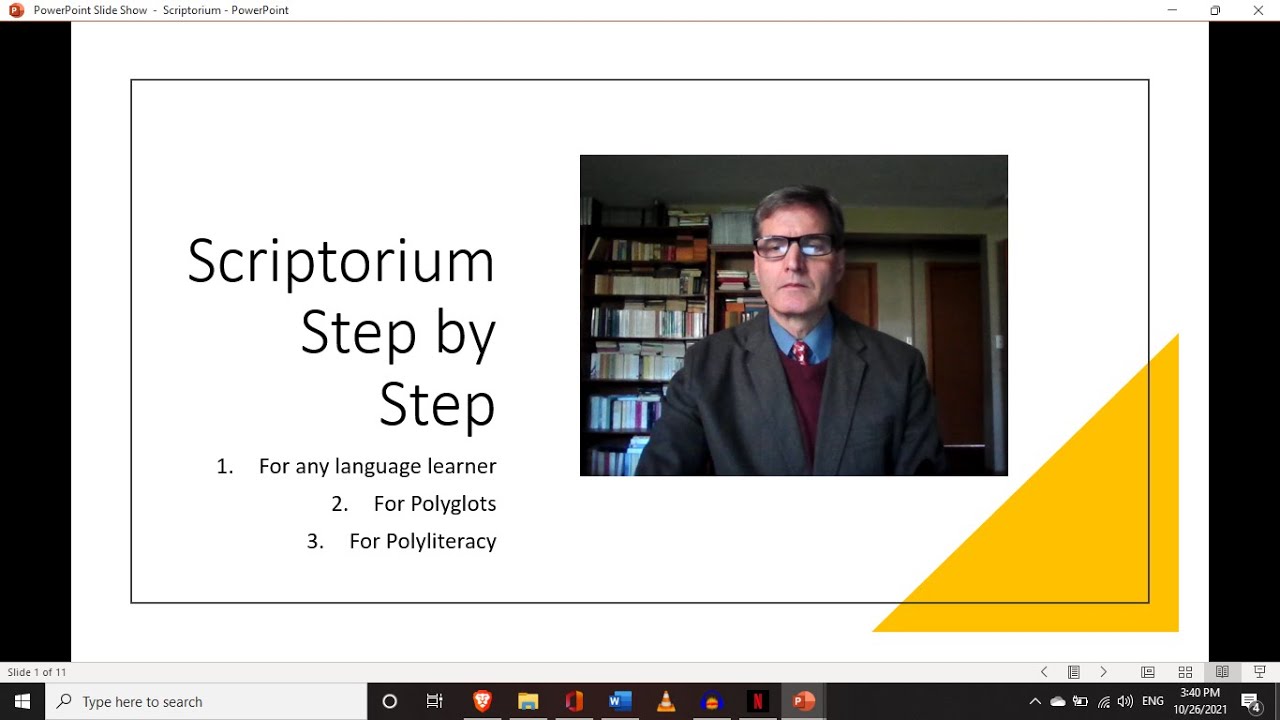
“The technique called Scriptorium, developed by Alexander Arguelles @ProfASAr who is a world-famous hyperpolyglot, which I have used to great effect to improve my reading and writing as well as speaking and listening abilities in many languages.”
And an important comment from the comment section:
“I do think you’re missing one core element in Prof Arguelles’s method - there is no cat in your lap. Not sure how you’re going to get any synapses firing without that key ingredient.”
For my exams.. i created mind maps, and then spent my time reproducing the mind maps over and over again. My study mind map was nice and neat and hand written. My reproductions were barely legible. Then look over what I missed. The location of the data seemed to help a lot.
The general concept is involve more and more of the different senses. In this case.. spacial location helps too.
Thank you. That is interesting, Bhante. I don’t have any experience using mind maps, but maybe I should investigate the technique now that I am back in school for a biochemistry degree.
The only memorization technique I’ve ever tried is the one from the video below. I haven’t used it since I tried the exercise in the video, but it worked well that time. I went from 3/10 in the control session → 9/10 using the technique. This technique appears to be a simpler one and less complicated than the mind maps.
Monks are not allowed to draw pictures of living beings. So I didn’t draw much. But putting notes on different sides of the paper (always landscape) helped me know what to put where. Useful for pure essay exams UK style.
In the course of the video from the original post, the presenter briefly pays tribute to the scribes of the past who transcribed the classics he is using in the video. Here is a direct link to that section of the video for those who do not remember it, or did not make it that far in the video:
I found this part very apt after having just recently watched an informative video about Kessler syndrome (note that Kessler syndrome is taken very seriously by scientists and is a scenario first proposed by NASA scientists Donald J. Kessler and Burton G. Cour-Palais in 1978). It appears that we, as a civilization, are very close to this.
Now imagine that this is the case. We would lose access to all internet servers (remember this is something that scientists take very seriously and are legitimately concerned about). Just imagine all the books and texts that would be lost, including digital religious texts of our tradition. I asked AI how many ebooks currently exist (including all copies and in all languages - just ebooks not all files), and the best answer I could get was that it is probably a number totalling in the tens of billions (this due to the fact that not all copies are accounted for in a single database, but it uses publishing data, sales data, and various metrics to come up with that estimate). So let’s take the smallest possible whole number that would satisfy this. That would be 10,000,000,000. AI also gave me a “solid, data-driven estimate” of how many words are contained in the average book (regardless of book type, print date, etc.) as between 70,000 and 80,000 words, so let’s take 75,000 words on average. That would put the total word loss at 750,000,000,000,000 (750 trillion) or 7.5 × 10¹⁴ words if we reach such aforementioned Kessler syndrome.
Now, how many words lost would that mean for our tradition (especially if we also included all relevant files of all file type formats, etc.)? I really don’t know the answer to that. But homage to those scribes is all I can say.
R
Ah, some good news:
If humanity reaches the point of Kessler Syndrome, we will not lose all computer servers, as the vast majority of computing infrastructure is ground-based. However, it would cause catastrophic damage to the satellite network, leading to a massive, long-term disruption of global internet, GPS, and communication services.
Here is a breakdown of the impacts:
What Would Be Lost
Satellite Constellations: A Kessler syndrome event creates a runaway chain reaction of collisions in low-Earth orbit (LEO), which would likely destroy or damage the majority of active satellites, including key internet constellations like Starlink.
Satellite Internet/TV/Phone Services: Services that rely on orbital satellites would experience widespread, prolonged outages.
GPS/Navigation: Global Positioning Systems would be heavily impacted, affecting air travel, navigation, and timing for critical infrastructure.
Weather Forecasting: Many weather satellites would be rendered inoperable, severely limiting our ability to predict natural disasters.
What Would Remain
Ground-Based Servers: Data centers, internet backbones, and server farms on Earth would continue to operate normally.
Undersea Cables: The primary, robust system for international data and communication, which handles the bulk of global internet traffic, would remain intact.
Terrestrial Communications: Fiber-optic networks, cellular towers (that do not rely on satellite backhaul), and local Wi-Fi would still function.
The Consequences of the “Shutdown”
Economic Disruption: The loss of satellite services could create massive economic disruptions and damage, with estimates placing the impact in the trillions of dollars.
Ineffective Space Access: It would become extremely dangerous and difficult, perhaps impossible for a time, to launch new satellites or travel through Low Earth Orbit.
Long-Term Debris: The debris from this chain reaction would persist for years or even decades, making certain orbital regions unusable.
While the scenario would cripple the space-dependent parts of our technological world, terrestrial computing infrastructure would continue to work, although it would be heavily overloaded as it tries to absorb the lost data traffic.
Anyhow, getting back to the technique. Let’s look at how the name was derived.
The scriptorium (“place for writing”) was a specialized room in medieval European monasteries where monks, or scribes, painstakingly copied, decorated, and preserved manuscripts by hand. Primarily active from the early Middle Ages, these centers of knowledge production utilized parchment, quills, and inks to create illuminated texts, playing a crucial role in transmitting classical literature and religious theology. Some famous scriptoria are ones such as the one at Monte Cassino in Italy and St. Martin of Tours in France.
In the Pāli-speaking world, while not “scriptoria” in the architectural sense, specific monasteries and institutions were vital hubs for copying and preserving manuscripts. A famous example is Āluvihāra (Alu Viharaya), Sri Lanka: This is the most direct historical equivalent in function. It is the revered site where the orally transmitted Pāli Canon was first written down on palm leaves*. And of course, historically, we have many such important monastic libraries in Theravāda countries. Monasteries across Sri Lanka, Thailand, Myanmar, Cambodia, and Laos have, for centuries, housed extensive collections of palm-leaf manuscripts. These have served as libraries and as centers where texts were copied and transcribed.
Returning to the technique. It is best used with any language by intermediate to advanced students, or for polyglots to “tend the garden”, as a way to continue practicing. It was originally developed by Alexander Arguelles, Ph.D., an American polyglot and linguist. Here is a video explaining the technique by Dr. Arguelles himself:
*I wrote a little about the importance of the palm-leaf manuscripts in the following thread:
"Dr. Mabel Bode in her excellent work, The Pāli Literature of Burma, gives a very good and complete account of monastic scholarship in Burma from the reign of Anawrahta down to the reign of Mindon-min. But no account, it seems, can give us a vivid picture of the literature and scholastic activities of the Kyansittha Onhmin or the Kyaukku Onhmin or numerous other monasteries of Pagan and the interior regions where away from the din and bustle of ordinary life, the bhikkhu conforming strictly to all the duties of the monastic Order, strove hard to master the sacred texts of the religion. There in the darkness and solitude of the library hall of the monastery he devoted whatever time he could, day in and day out, in reading the works most suited to his line of study, and writing down on palm leaves the thoughts and comments of his own, not for any earthly fame or gain, but as a work of merit.
The Gandhavaṃsa, the Sāsanavaṃsa and other chronicles give a long list of such monk-scholars and philosophers, and a longer list of their works, but even these lists must represent only a fraction of the good and continuous work that was carried on in the network of monasteries spread all over the country. No subject was too unworthy for their study; and though naturally Buddhism in all its various aspects and branches demanded the most serious and careful attention, subjects like grammar, logic, medicine, astrology, astronomy, polity, law, prosody, metres, and even war, etc., claimed their time and labour, grammar being one of the most important. If this may help to give us a rough idea of the busy but silent scholastic life in the monasteries that continued through generations of thera-paramparā."
—Ray, Niharranjan, Theravāda Buddhism in Burma, 1945, p. 125