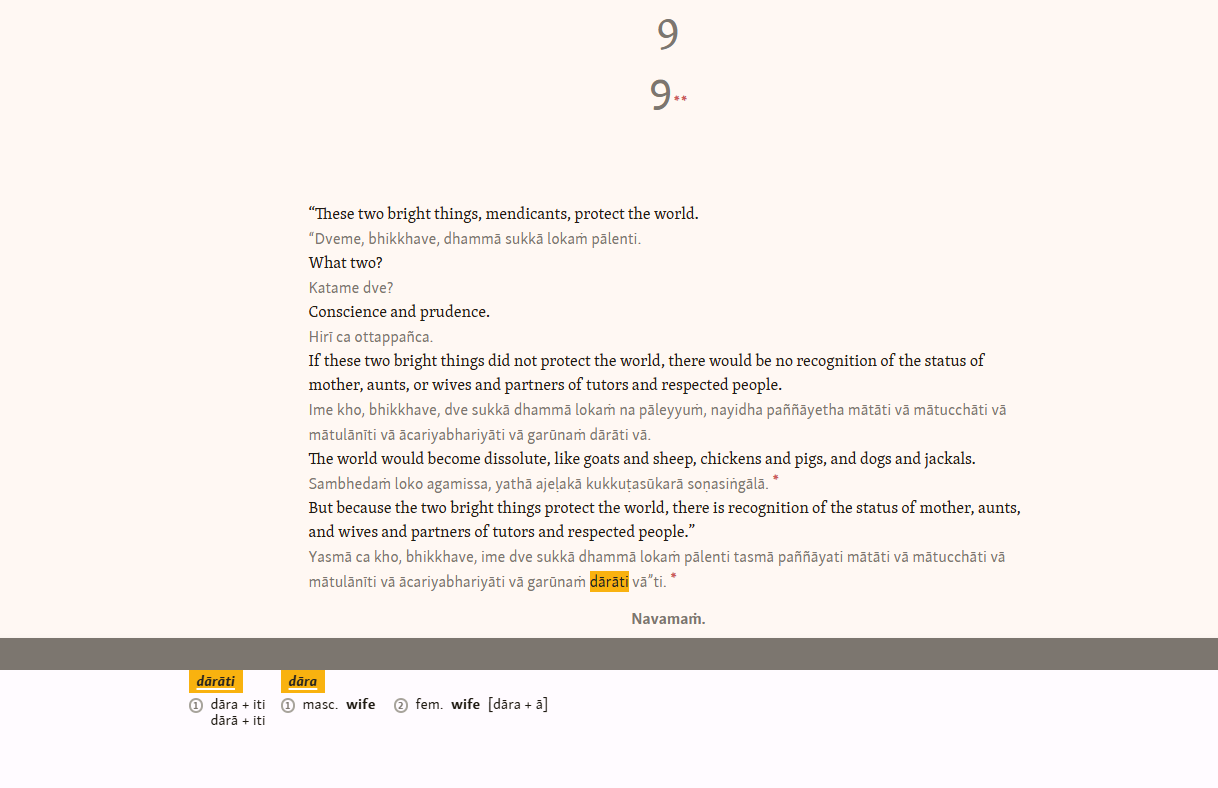
I admit, Suttacentral is easy to use. I can find what I want quickly, but the translations are adding color to the translations.
Why? Instead of “wives” he is using the word “wives and partners”.
Here is the original pali for an 2.9
Ime kho, bhikkhave, dve sukkā dhammā lokaṁ na pāleyyuṁ, nayidha paññāyetha mātāti vā mātucchāti vā mātulānīti vā ācariyabhariyāti vā garūnaṁ dārāti vā.
Suttacentral translation:
If these two bright things did not protect the world, there would be no recognition of the status of mother, aunts, or wives and partners of tutors and respected people.
I picked up on this, and asked ai why SuttaCentral would do something like this?
GPT 4o Answer
A literal translation would be:
“Bhikkhus, if these two bright qualities did not protect the world, there would be no recognition of ‘mother,’ ‘mother’s sister,’ ‘mother’s brother’s wife,’ ‘teacher’s wife,’ or ‘the wives of respected elders.’”
The Key Term: “dārā”
dārā is the plural form of dāra, which in classical Pāḷi normally means wife or spouse.
In the PTS Pāli-English Dictionary:
“dāra (m. pl.) = wives”
So:
garūnaṁ dārā = “the wives of respected elders”
Why do some translations say “partners”?
Some modern translators choose “partners” to make the text gender-neutral or contemporary, reflecting modern usage (e.g., same-sex couples or non-married relationships), but this is not supported by the Pāḷi.
In classical Theravāda understanding, especially from the commentaries, dāra clearly refers to wife (lawful spouse, female).
Here we can conclude that the translation has been colored.
Yes. Definitely one of the shortcomings of having such strong political opinions - like what happened with a lot of modern western scholars and the throwing out of commentaries/the garudhammas/rebirth as an intricate metaphor.
I dont even disagree with SC that much on political stuff, but they have such strong, in your face, snobby opinions about thier identity politics (despite thier insistence on how super important no identity view is), its almost impossible to believe they wouldnt try to use modern feminist pronoun culture on ancient Indian texts from 2000+ years ago.
Just scrolling thru thier forum for a few minutes, i wouldnt be shocked if Bhante Sujato came up with some rationalization to say suttas where the Buddha says “men and women” as a way of referring to “everybody” were really “late” texts. And that the real early Buddhist texts did not use such LGBTQIA+ exclusionary language - despite the phenomena not occurring in popular western culture until the 21st century.
It is truly revolting that they insert their mental distortions right into the Suttas. Many individuals tailor the texts to suit their own ulterior motives.
If it be checked the other translations of this passage in different languages, it will be found that they explicitly mention the inclusion of the wives of honourable men — clearly and directly, in a straightforward way true to the original Pāli text, without this sugar-coated, gender-neutral language that slips poison into honey. This is precisely what one would call distortion.
Just so the record is clear. Here are 2 more “traditional” translations along with the original. Taken from digital pali reader online and ehem.. suttacentral.
9. “dveme, bhikkhave, dhammā sukkā lokaṃ pālenti. katame dve? hirī ca ottappañca. ime kho, bhikkhave, dve sukkā dhammā lokaṃ na pāleyyuṃ, nayidha paññāyetha mātāti vā mātucchāti vā mātulānīti vā ācariyabhariyāti vā garūnaṃ dārāti vā. sambhedaṃ loko agamissa, yathā ajeḷakā kukkuṭasūkarā soṇasiṅgālā {soṇasigālā (sī. syā. kaṃ. pī.)} . yasmā ca kho, bhikkhave, ime dve sukkā dhammā lokaṃ pālenti tasmā paññāyati {paññāyanti (sī.)} mātāti vā mātucchāti vā mātulānīti vā ācariyabhariyāti vā garūnaṃ dārāti vā”ti. navamaṃ.
Ajahn Thanissaro
2.9. Guardians of the World
“Monks, these two bright qualities guard the world. Which two? Conscience & concern. If these two bright qualities did not guard the world, there would be no recognition of ‘mother’ here, no recognition of ‘mother’s sister,’ ‘uncle’s wife,’ ‘teacher’s wife,’ or ‘wife of those who deserve respect.’ The world would be immersed in promiscuity, like rams with goats, roosters with pigs, or dogs with jackals. But because these two bright qualities guard the world, there is recognition of ‘mother,’ ‘mother’s sister,’ ‘uncle’s wife,’ ‘teacher’s wife,’ & ‘wife of those who deserve respect.’”
17“Bhikkhus, these two bright qualities protect the world. What two? Moral shame and moral dread. If these two bright qualities did not protect the world, there would not be seen here [any restraint regarding] one’s mother, aunts, or the wives of one’s teachers and [other] respected people.226 The world would become promiscuous, like goats and sheep, chickens and pigs, dogs and jackals. But because these two bright qualities protect the world, there is seen here [restraint regarding] one’s mother, aunts, or the wives of one’s teachers and [other] respected people.”
Using an LLM to prove your point seems a bit odd. LLMs are only regurgitating source material thrown into them. By definition they are only going to give statistically probably output from that. So naturally they won’t be able to support a novel interpretation.
Also, words often need to be translated in different ways depending on the context.
If Bhante Sujato was trying to be sneaky, he certainly wouldn’t be presenting his translations line by line with the Pali.
Since this is Classical Theravada, I’d really love to see any commentarial information on the relevant passages.
Even by his own line by line in-web translator, it says wife, not something gender neutral like spouse/partner. If someone translated the French word frere (brother) into English as a gender neutral “sibling”, that is not contextualizing or something like that. That is distorting the meaning of the words being translated because you are too “self” absorbed and attached to your political views and wanted to pat your back as a feminist ally and not hurt the feelings of “sisters” by excluding them in the translation when the original word meant brother. I have no issue with pronouns or gender neutral words. But he clearly let his leftist political opinions creep into his translations. This is the problem with being too strongly opinionated and “self” absorbed with your political views/or any view. Which Bhante Sujato is when you look at his SC forum posts. If you cling too strongly to your views, your views inform your facts rather than the facts informing your views. Its why the Buddha emphasized letting go of your self/identity/ego and not just making it an unabashed part of your monk profile.
Okay sure. but darati does not mean partner, it means wife. im sure Pali has another word for partner. Just like in English, wife means wife and shouldnt be translated into Thai/French/Spanish as something gender neutral. In Thai, wife should be translated as “meear” (wife), not “fan”, a gender neutral Thai word basically meaning girlfriend/boyfriend.
Cariyāpiṭaka Aṭṭhakathā – Commentary and Ṭīkā on the Ninth (Navamaṃ) Verse
Aṭṭhakathā (Commentary)
Navame lokaṃ pālentīti
In the ninth (verse), “they sustain the world” means
lokaṃ sandhārenti ṭhapenti rakkhanti.
they support, uphold, and protect the world.
Nayidha paññāyetha mātāti
“In this world, a mother would not be recognized” means
imasmiṃ loke janikā mātā ‘‘ayaṃ me mātā’’ti garucittīkāravasena na paññāyetha.
in this world, the birth mother would not be known as “this is my mother” due to the absence of a respectful mental attitude.
Sesapadesupi eseva nayo.
The same explanation applies to the other terms.
Sambhedanti
“Disruption” means
saṅkaraṃ mariyādabhedaṃ vā.
intermixing or breaking of boundaries.
Yathā ajeḷakātiādīsu
Just as in the case of goats and sheep, etc.,
ete hi sattā ‘‘ayaṃ me mātā’’ti vā ‘‘mātucchā’’ti vā garucittīkāravasena na jānanti.
these beings do not recognize “this is my mother” or “this is my aunt” due to the absence of respectful awareness.
Yaṃ vatthuṃ nissāya uppannā, tattheva vippaṭipajjanti.
Even though they are born from a particular source (womb), they behave improperly even there.
Tasmā upamaṃ āharanto ‘‘yathā ajeḷakā’’tiādimāha.
Therefore, bringing a simile, the text says, “Just as goats and sheep,” and so on.
Navamaṃ.
(The ninth stanza.)
Ṭīkā (Sub-commentary)
Navame lokanti sattalokaṃ.
In the ninth, “world” means the world of beings.
Sandhārentīti ācārasandhāraṇavasena dhārenti.
“Support” means they uphold (the world) through maintaining moral conduct.
Ṭhapentīti mariyādāyaṃ ṭhapenti.
“Establish” means they establish (the world) within proper boundaries.
Rakkhantīti ācārasandhāraṇena mariyādāyaṃ ṭhapetvā rakkhanti.
“Protect” means they establish proper boundaries through moral conduct and then guard them.
Garucittīkāravasena na paññāyethāti
“Would not be recognized with a sense of respect” means
garuṃ katvā citte karaṇavasena na paññāyetha, ayamācāro na labbheyya.
one would not mentally acknowledge respect; this kind of conduct would not be found.
Mātucchāti vāti ettha iti-saddo ādyattho.
“Including ‘maternal aunt,’ etc.” — here the particle vā is used in the inclusive sense.
Tena mātulānīti vā ācariyabhariyāti vā garūnaṃ dārāti vāti ime saṅgaṇhāti.
This includes mātulānī (uncle’s wife), ācariyabhariyā (teacher’s wife), and garūnaṃ dārā (wives of elders).
Tattha mātu bhaginī mātucchā.
Among these, the mother’s sister is the mātucchā.
Mātulabhariyā mātulānī.
The wife of one’s maternal uncle is mātulānī.
Garūnaṃ dārā mahāpitucūḷapitujeṭṭhabhātuādīnaṃ garuṭṭhāniyānaṃ bhariyā. Garūnaṃ dārā refers to the wives of revered persons like one’s father’s elder brother (mahāpitu), younger brother (cūḷapitu), eldest brother (jeṭṭhabhātu), and others worthy of respect.
Yathā ajeḷakātiādīsu ayaṃ saṅkhepattho –
As for “Just as goats and sheep,” the summarized meaning is this:
yathā ajeḷakādayo tiracchānā hirottapparahitā
Just as animals like goats and sheep are devoid of moral shame and fear of wrongdoing,
mātāti saññaṃ akatvā bhinnamariyādā sabbattha sambhedena vattanti,
not recognizing a mother as such, they transgress all boundaries and act with indiscriminate mixing.
evamayaṃ manussaloko yadi lokapāladhammā na bhaveyyuṃ, sabbattha sambhedena vatteyya.
In the same way, if the world-protecting Dhammas (lokapāla-dhammā) did not exist, the human world would behave with complete intermingling.
Yasmā panime lokapālakadhammā lokaṃ pālenti, tasmā natthi sambhedoti.
But because these world-protecting Dhammas do protect the world, such intermingling does not occur.
One of the appropriate ways to examine this matter is by consulting other translations, which, in fact, do not include what is found in Sujato’s rendering.
Surrounding him with arbitrary coverage does not change the fact that he added this term to his version to create a sense of satisfaction in the hearts of those concerned with that part.
In any case, here is another translation of the passage that is not widely available to everyone:
Bhikkhus, these two white dhammas guard the world. What are the two? They are: 'having a sense of shame (to do evil), and ‘having a sense of fear (to do evil)’. Bhikkhus, if these two white dhammas did not guard the world, there would not be such distinction, among men as ‘mother’, ‘mother’s elder and younger sister’, ‘uncle’s wife’, ‘teacher’s wife’, or ‘respectable person’s wife’. (in that case) this world would be mixed up with the world of goats, sheep, chickens, pigs, dogs, and jackals.
Bhikkhus, because these two white dhammas guard the world, there is such distinction among men as ‘mother’, mother’s elder and younger sister, ‘uncle’s wife’, teacher’s wife or ‘respectable person’s wife’. (Thus said the Bhagavā.)
— Thein Maung, U. (trans.). Aṅguttara Nikāya. (Yangon: D.P.P.S., 2000), p. 100
There are more translation examples of gender-neutral terms that Ajahn Sujato uses. They use “they”. Somehow I missed this, but Grok is good at picking out biased infiltrations for translations. One should also know that mendicant is a gender-neutral term as well. Therefore, when the Buddha is talking to monks, a female can “relate” to it as well. The usage of mendicant as gender-neutral did not occur to me to have woke connotations until now.
Bhikkhu Sujato MN 20 (Woke)
Take a mendicant who is focusing on some subject that gives rise to bad, unskillful thoughts connected with desire, hate, and delusion. That mendicant should focus on some other subject connected with the skillful. As they do so, those bad thoughts are given up and come to an end.
Bhikkhu Bodhi
“Here, bhikkhus, when a bhikkhu is giving attention to some sign, and owing to that sign there arise in him evil unwholesome thoughts connected with desire, with hate, and with delusion, then he should give attention to some other sign connected with what is wholesome. When he gives attention to some other sign connected with what is wholesome, then any evil unwholesome thoughts connected with desire, with hate, and with delusion are abandoned in him and subside.
Yes I also saw this recently, Venerable Sir. I think “monks” is a better translation of the word Bhikkhu.
I remember seeing something related to this in the commentary to Vipallāsakathā of the Patisambhidamagga. According to this, I think ‘monks’ is indeed a better translation of ‘Bhikkhu’ than mendicant. ‘Bhikkhu’ does refer to monks. It shouldn’t be a gender-neutral term. Monks are the primary recipient of the Dhamma and they are also the eldest in the assembly because they came first before any lay people or nuns.
Bhikkhū refers to persons fit to listen to the discourse.
“Bhikkhū”ti kathāsavanayuttapuggalavacanaṃ.
Here the meaning of the word should be understood according to the method beginning:
Idha panassa vacanattho iminā nayena veditabbo —
“A beggar is called a bhikkhu; one who has undertaken the practice of alms-going is a bhikkhu.”
“Bhikkhakoti bhikkhu, bhikkhācariyaṃ ajjhupagatoti bhikkhū.”
(Vibhaṅga 510; Pārājika 45)
If one asks:
Sace koci puccheyya —
“Why does he address only the monks when gods and humans are also present?”
“Aparesu devamanussesu vijjamānesu kasmā bhikkhūyeva āmantesī?”
Because they are:
The eldest in the assembly (being first to arise)
Jeṭṭhā sabhāya paṭhamuppannattā.
The foremost (having gone forth and following the Teacher’s conduct, and being the primary recipients of the whole Teaching)
Seṭṭhā anagāriyabhāvaṃ ādiṃ katvā satthu cariyānuvidhāyakattā sakalasāsanapaṭiggāhakattā ca.
The nearest (being seated close to the Teacher)
Āsannā satthusantikā nisinnattā.
Constantly present (dwelling near him)
Sadāsannihitā satthusantikāvacarattā.
The proper vessel for the Dhamma (capable of practicing as instructed)
The Blessed One’s Dhamma-teaching is common to the whole assembly.
Bhagavato hi dhammadesanā sabbaparisasādhāraṇā.
But within the assembly, the monks are eldest, foremost, nearest, constantly present, and fit receptacles for the teaching.
Parisāya pana bhikkhū jeṭṭhā seṭṭhā āsannā sadāsannihitā dhammassa ca bhājanabhūtā.
Therefore he addresses the monks first.
Tasmā bhikkhūyeva paṭhamaṃ āmantesi.
“Āmantesi”
“Āmantesi” means: he addressed, he spoke to, he called to attention.
“Āmantesī”ti ālapi, abhāsi, sambodhesi.
Elsewhere it can also mean informing or summoning.
Aññatra pana ñāpanepi pakkosanepi.
“Bhikkhavo”
“Bhikkhavo” indicates the manner of address.
“Bhikkhavo”ti āmantanākāradīpanaṃ.
By this word — established through qualities such as being accustomed to begging, being devoted to begging, and excellence in begging conduct —
Tena vacanena bhikkhanasīlatā-bhikkhanadhammatā-bhikkhanesādhukāritādiguṇayogasiddhena —
he reveals a way of life shared by both lower and higher people, and restrains arrogance and dejection.
Hīnādhikajanasevitaṃ vuttiṃ pakāsento uddhatadīnabhāvaniggahaṃ karoti.
Moreover, by this word — preceded by the outpouring of compassion and the gentle expression of heart and eyes —
Aparaṃ pana karuṇāvipphārasommahadayanayananipātapubbaṅgamena vacanena —
he brings them face-to-face with himself.
Te attano mukhābhimukhe karoti.
By that very word, which indicates his wish to speak, he arouses in them the desire to listen.
Teneva kathetukamyatādīpakena vacanena nesaṃ sotukamyataṃ janeti.
And by that word of address, he directs them toward careful listening and proper attention.
Teneva ca sambodhanatthena vacanena sādhukasavanamanasikārepi te niyojeti.
For the success of the Teaching depends upon careful listening and proper attention.
Sādhukasavanamanasikārāyattā hi sāsanasampatti.
While I do appreciate the critic on translation accuracy, I don’t appreciate it evolving to a promotion for patriarchy.
Buddha’s teachings when addressed to monks are most of them basically can be addressed to nuns as well without any change in the contents other than gender flip the pronouns. I think it’s more like people should use their wisdom to do so, but not to use this as justification of making women second class in the religion.
There’s enough materials in the texts itself to have nuns bowing to monks etc, but we as living tradition don’t have to rub it in people’s faces.
Why are you saying it is evolving when a translation is a translation? When The Buddha addresses monks … he is addressing monks. When The Buddha addresses bhikkhunīs, he is addressing bhikkhunīs. It is as simple as that.
What is done here by gender-neutral terms—changing gender and even plural or singular forms—is changing the translation.
The stupid-funny-ironic part about the EBT people, and I mean those who compare Pāli with parallels in corrupt Chinese texts, translated multiple times from heretical factions. I’m talking about those EBT’ers who go shooting their mouths off saying, “They added this, they removed this!” These same EBT’ers translate in the same distorted way that they falsely accuse our elders of doing.
Why do they accuse the elders of distorting the dhamma? Because the EBT’ers do this themselves.
Well, I hope he changes this philosophy and changes his translations. It seems to be a very subtle way to rewrite the perspective of the suttas and how they are to be read. I didn’t notice this until very recently. Because I have been “fooled” on this topic for so long, it makes me feel like I have been lied to.
I highly doubt he will change the translation, and many free physical copies of his translations are being distributed. Also, he asked people to not put his translations into AI.
Only another fully copyright free translation which is more accurate to the Pāli might be able to change people’s preferences.
Really? I noticed it the first time I ever saw his translations. Seems like it didn’t interfere with you thinking the Buddha was addressing you.
I’ve mentioned this before, but the fact that his translations are presented side by side with the Pali, with a lookup function to help read the Pali gives him some flexibility in translation. All translators have biases. It’s just that not all of them are upfront about them. We can’t accuse him of trying to pull a fast one on us when he is explicit with what he is doing.
The Key Term: “dārā”
Why do some translations say “partners”?
 9. “dveme, bhikkhave, dhammā sukkā lokaṃ pālenti. katame dve? hirī ca ottappañca. ime kho, bhikkhave, dve sukkā dhammā lokaṃ na pāleyyuṃ, nayidha paññāyetha mātāti vā mātucchāti vā mātulānīti vā ācariyabhariyāti vā garūnaṃ dārāti vā. sambhedaṃ loko agamissa, yathā ajeḷakā kukkuṭasūkarā soṇasiṅgālā {soṇasigālā (sī. syā. kaṃ. pī.)} . yasmā ca kho, bhikkhave, ime dve sukkā dhammā lokaṃ pālenti tasmā paññāyati {paññāyanti (sī.)} mātāti vā mātucchāti vā mātulānīti vā ācariyabhariyāti vā garūnaṃ dārāti vā”ti. navamaṃ.