I am somewhat late in returning to this topic but thought it worthwhile to highlight a few points, which are of course just personal points of someone who has been living in Thailand these past 15 years.
1st: regarding academics recent focus on so called “old meditation traditions”.
If you call something “Tantric Theravada” it is sexy, exciting and causes cognitive dissonance. You will get interest and hence funding etc.
If you say something is dying out, then you are preserving it and you are saving it etc. In the same way these traditions are not Tantric, they are not dying out, in some areas they are the majority.
The Dhammakaya movement with it’s vast wealth has been promoting research on them to reinforce the appearance of tradition and orthodoxy of their own system. (Many of these researchers make use of this funding).
2nd: with regards to the differences with the reformed systems of the Burmese Sayadaw, it is essential to read their actual writings which are often full of similarities in terms of non-canonical chanting, magical medicine practices and initiation practices with the meditations too. For example read the following by Daniel M. Stuart:
3rd: Before placing judgment on how orthodox or not the “old meditation” traditions (and there are many different systems) you need an overview of the system. This has not been done, with the closest being by Gregory Kourilsky:
4th: Many of the things that are seemingly most striking are part of the common mainland south East Asian heritage. The yantras, tattoos, vast arrays of offerings etc are not integral to the meditation system itself. It was also a prerequisite to have an initiation to learn just about anything in the past, which is still echoed in Wai Kru ceremonies in every school in Thailand.
5th: and finally for today, the old meditation systems are built on the same meditation methods found in the Visuddhimagga and the canon in much the same way as the Burmese systems. Some temples even combine the two traditions such as Wat Lokmolee in Chiangmai. Those actual practitioners, rather than armchair academics don’t always see an opposition, rather relying on which practices from each which work best.
That said I absolutely recommend on relying on the authentic masters of the tradition you practice rather than thinking we are wise enough to pick and choose what we think is best.
some excerpts:
In a letter to his meditation teacher, Sayagyi U Ba Khin (1899-1971), dated July 8, 1969, the
now-famous Vipassanā meditation teacher S. N. Goenka (1924-2013) reported as follows on the very
first Vipassanā “camp" (śivir) he taught in India: ..” I felt myself fortunate enough to *have been chosen for this meritorious job, to work as your transformer to induct the powerful * nibbāna-dhātu from your power house and shower it on the candidates in front of me. “
Despite S. N. Goenka’s historical importance, and that of his teachings and
practices, the tradition of practice he disseminated remains poorly understood.
The present article emerges from a larger project aimed at a comprehensive
historical accounting of the background and development of Goenka’s meditation
lineage. A fundamental set of problems stands at the center of such a
project: Is it possible to make this lineage historically legible to contemporary
audiences when much of its history has been deliberately obscured by its own
progenitors?
[..] I would draw attention
to how S. N. Goenka conceptualizes the moment of teaching the meditative modality of Vipassanā,
which became the sine qua non of his teaching mis- sion. He notes that under his teacher’s
“immediate guidance … Every batch received the sparkling illumination of nibbāna-dhātu which this
land of the Buddha had lost contact with since the last two millenniums.” He goes on to emphasize
to his teacher that “I felt myself fortunate enough to have been cho- sen for this meritorious job,
to work as your transformer to induct the powerful nibbāna-dhātu from your power house and shower
it on the candidates in front of me.”
What is going on here? What does it mean that, for Goenka, the teaching of Vipassanā involved
showering meditation students with nibbana-dhātu under the immediate guidance of a teacher, a guru,
who was at a physical remove in Rangoon? What was the mechanism – in emic terms – by which Goenka
car- ried out such acts of transmission? To answer these questions, we must recover the
meditation-teaching contexts within which Goenka was trained in the 1950s and 1960s in postcolonial
Rangoon. In doing so, I would like to thema- tize the notion of “performance” along several
intersecting axes of thought and practice that are embedded in the multifaceted worlds of
traditional Burmese religious frameworks.
When Goenka speaks of “induct[ing] the powerful nibbāna-dhātu from [U Ba Khin’s] power house and
shower[ing] it on the candidates in front of [him],” he is in fact referring to an initiatory
performance that he carried out on every
single Vipassanā meditation course he ever taught.
[..] I suggest that a historical recovery of some of the performative aspects of
U Ba Khin’s teaching modalities at the International Meditation Centre (IMC) in Rangoon allows
scholars to discern a connection between U Ba Khin’s meditation-teaching practices and some of the
ritual-healing modalities rep- resented in the Ledi Sayadaw’s Manual for Warding Off Pestilence. I
argue that such connections should also force scholars to reframe how they think about the Ledi
Sayadaw’s conception of meditation and his political organizing around Buddhist textual learning.
That is, the apotropaic aspects of Burmese Buddhist textual practice are foundational for both the
Ledi Sayadaw’s program of learning and his program to encourage more people to practice meditation.
These aspects of the Ledi Sayadaw’s outlook come into relief only when we view them in connection
with U Ba Khin’s later redeployment of the Sayadaw’s
ritual-healing incantations.
[..]
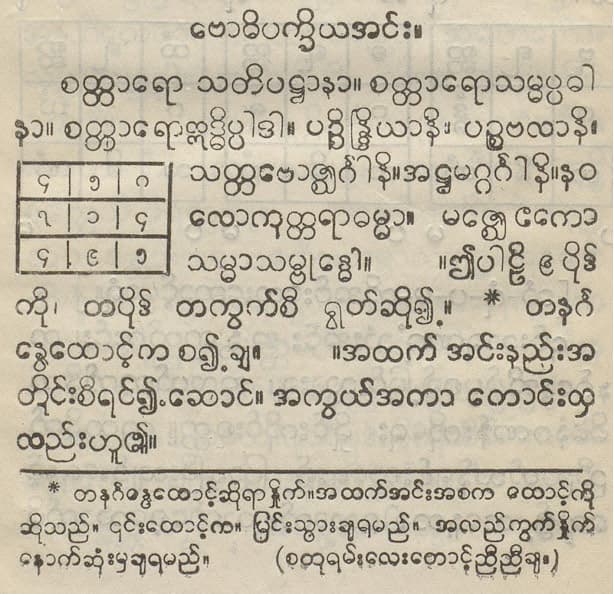
We find in the Rogantaradīpanī
a number of healing spells that involve the ingestion of text in written, yantric form. The
instructions for how to utilize the Bodhipakkhiya-yantra (Figure 3), a powerful talismanic emblem
encapsulating the force of the Abhidhamma, run as follows:
In writing the words in each diagram begin from the Sunday’s House, i.e. the top left corner, and
proceed after the Myin-nthwar method. In the center put the number indicative of your birthday.
Write those words neatly on local bamboo-pulp paper. Burn them and take the ashes with water daily.
After taking them as many number of times as one’s age, it gives protection against evil spirits.
The more the number of times taken, the greater one will become.
In case of danger, prepare those diagrams (on a sheet of tin or brass), tie it with red thread
consecrated with seven repetitions of the Twenty-eight Buddhas Charm and the Invocation of the Powers of the Seven
Buddhas and put them with consecrated threads around children’s neck
and wrists. Gold or silver sheets may also be used.
Ledi Sayadaw, n.d.: 346
Perhaps the most important aspect of U Ba Khin’s Vipassanā meditation teaching model was the way in which it was premised on his identity as a special individual, a bodhisattva, with special access to the cosmic forces that support the Buddha’s teachings (sāsana) (Stuart 2020: 52, 106, 115; forthcoming). In this connection, his model of Vipassanā practice heavily emphasized the role of the meditation teacher in the process of meditation. In an oral discourse during a meditation retreat in the early 1960s, U Ba Khin explained to his Burmese students his understanding of his particular role as a meditation teacher:
You will find out that meditation by yourself does not work. However you try to calm your mind, only the time will be gone, and your mind will not be calm. Yet, if you practice with teachers who have the ability to protect you, you will get samādhi. For this reason, the Buddha said: yathābhūtañā nāya satthā pariyesitabbo—“For knowledge of things as they are, teachers should be approached.” Without a teacher, there is no way. The guidance and protection from a teacher are very important. There are pulling forces (’achvai dhāt‘ tve အဆွဲဲဓါတ််တွေ) in the environment, and they disturb concentration. If a teacher protects [a meditator] from these forces and disturbances, a meditator who is working for samādhi can get concentration. After getting calmness of mind, there is cittavisuddhi (purity of mind), and the characteristic of cittaekaggatā (one-pointedness of mind) appears. At that time only, Vipassanā meditation should be practiced.
(Ba Khin, n.d. [1962?] 7.1: 19:30–20:47)
Here U Ba Khin makes clear that successful meditation, particularly in the beginning stages of concentration practice, necessitates the protection of a teacher who can ward off cosmic disturbances, or “pulling forces,” that disrupt progress in meditation. The use of the term dhāt‘ (Pāli: dhātu) here to connote a variety of types of “forces”—bodily forces, mental forces, and supernormal agentive forces of various material types—also demonstrates how U Ba Khin participated in a Burmese Buddhist metaphysics in which human experiential matrices are constructed by and thoroughly enmeshed in a set of interpenetrating cosmic relationalities. This perspective takes for granted a grand Buddhist cosmology of various realms of existence, large timescales of cosmic decline and re-emergence, and a theory of rebirth. Most importantly for our purposes here is that U Ba Khin’s teaching model was intimately concerned with the ways in which most meditators, at the beginning of their practice, must first deal with a range of obstructing forces that keep them from succeeding in gaining concentration. In U Ba Khin’s model, the indispensable work of a teacher involved the capacity to discern the influence of such forces and dispatch them by dint of his power over them.
But how did this work in practice? There is very little historical evidence to answer this question, but some written accounts, and accounts gathered through ethnographic research, provide some insights into U Ba Khin’s methods. The diary of John Hislop, who learned meditation from U Ba Khin in 1960, provides a striking account of U Ba Khin’s teaching approach:
Then, when I was directed to give my attention to the fontanel area of the skull, and the area was calmly held in the attention without interfering thought movements of any type, then that “door” in the top of the head so easily and quickly opening to the burning heat—the sensation of “Anicca,” and the quick awareness of Anicca in other parts of the body. All this could not be my unaided doing. So I asked U Ba Khin this morning how come my mind suddenly became so tranquil, collected, and one-pointed, and if I had not had help. He said, yes, that the awakening to the sensation produced by the complete instability of matter could not occur without Samādhi of a high order, so he requested the devas and brahmās of this place who were liberated through the teachings of the Buddha and who gladly help by smoothing the circumstances if they can “tune in”—these sentient beings he asked to extend their beneficial influence to a man about to receive the Dhamma of the Buddha. Then I asked him about the easy opening of the fontanel “door” in the head, and he said, yes, this was by virtue of the same grace. The head area still burns strongly
Chit Tin 1985: 10–11
We see here how the top of the head of the meditation practitioner is a key
point of entry for the practice of awareness of sensations – leading to an experiential
understanding of the Buddhist principle of comprehensive impermanence
(anicca). This mode of practice is the hallmark of U Ba Khin’s technique.
[..]
We thus find the performative invocation of the literal substance of the
Buddha’s sāsana at the center of U Ba Khin’s Vipassanā teaching/practice
model. Through this performance, he draws supernormal beings to the
space of the meditation center and brings their “force” or dhāt into the body
of the meditation student by way of the “door” at the top of the practitioner’s
head. This should bring to mind the moment with which this article began.
When S. N. Goenka writes that he felt himself “fortunate enough to have been
chosen for this meritorious job, to work as your transformer to induct the
powerful nibbāna-dhātu from your power house and shower it on the candidates
in front of me,” during the first Vipassanā meditation course he taught in
India in 1969, he is referring to precisely such a process – precisely such
a performance – and his own Hindi-language version of U Ba Khin’s text,
presented above.
S. N. Goenka would go on to recite this text to hundreds of thousands of
students as an initiatory incantation on every single meditation course he
taught during his lifetime. And the text continues to be used in the very same
way in digital form on all ten-day Vipassanā courses taught at the hundreds
of meditation centers that Goenka and his students established around the
world. But most contemporary students coming to S. N. Goenka’s Vipassanā
courses in the twenty-first century have no knowledge, and may never gain
any knowledge, of the ontological framework that undergirds the initiatory
performances and daily protective recitations that are central to constructing
the experience of these ten-day Vipassanā courses. Goenka did a very good job
of effacing his ontological commitments through the rhetoric of science and
Indian secular pluralism. He did this at times deliberately, at times unwittingly.
It is all the more instructive, therefore, to recover the context of U Ba Khin’s
teachings, so that we might more fully comprehend Goenka’s, which have been
highly influential.
p.285 U Ba Khin’s teachings and practices were embedded in a highly elaborate mythological and millennial timescape structured around traditional Theravāda cosmology, within which U Ba Khin and his close disciples were on a cosmic mission to re-enliven the teachings of the Buddha in a degraded colonial and postcolonial age. Their goal was to bring karmically ripe individuals to states of enlightenment as quickly as pos- sible or to set karmic intentions for future rebirths such that they might be reborn at the time of the future Buddha, Metteyya. Because the small cult that
formed around U Ba Khin considered him to be a special bodhisattva – the being destined to become the future Buddha Metteyya – the various forms of meditation that he tailored to suit individual students were all considered to have an equivalent force based primarily on U Ba Khin’s own charisma and his karmic connection to powerful nonhuman awakened beings who protected his students and his meditation center. Finally, precisely because U Ba Khin was considered to have special karmic prowess as a teacher, there was among his disciples a strong devotionalism to him as a guru figure, a devotionalism tied explicitly to locale and sect. In some contexts, U Ba Khin himself becomes an object of devotion for his students, a wholesome object or ārammaṇa
Thank you for highlighting some of the quotes I was thinking of.
BTW just a heads up:
Someone has filled all the links on the Wikipedia topic on this subject with obvious AI slop, it was untrustworthy before, now although the references are mostly legit the content is garbage: