I have never seen Sayadaw mocking other monks and I will look at the quotes above and look up his light being present at time of realisation of Nibbana. But I think your accusations about him needing to apologize etc are judgements that are extreme and based on misunderstanding on your part. Unfortunately I can’t talk with Sayadaw at present but I know he would rattle off the quotes he made. I don’t remember anything he said not being based on something in the texts. Even when I started looking through the end of visuddhimagga last night I see where he got all his instructions for meditators. And I did talk to him about at what point in his life did he realise the visuddhimagga was so important.
1 Like
I think it is not repeatable unless one had mastery of jhana and used that as the basis for attainment:
The entering of the attainment with the object of Nibbāna is repeatable and never lost. As for the remaining four masteries, it seems logical as you say, but I cannot confirm this.
I have asked about this in a similar way, “How is it possible to lose jhāna but not Nibbāna attainment?”
The answer was given to me something like, “Some people can do kasiṇa-jhāna but not ānāpāna-jhāna. Some objects are easier than others.”
All arahants attained jhana (Samma-sati and Samma-samadhi).
All arahants have Patisambhida-nana (analytical knowledge).
Jhana is not the same as abhinnana, which is not all arahants possess.
All arahants observed nama and rupa and realised anicca, dukkha and anatta.
Venerable Ananda became an arahant when he was about to relax - halfway between standing and lying down. Was he able to dwell in Nirodha Sammapatti?
1.2 The Sutta opens with Sāriputta teaching a congregation of monks, presumably including Ānanda and Upavāṇa. Sāriputta teaches that it is possible for a monk who is accomplished in the 3 trainings to attain the cessation of perception and feeling (or, simply “cessation”) [2.2], that is, attain arhathood or non returning [§2]. If such a person does not attain arhathood in this life, then he would be reborn in the pure abodes [§§3 etc, 14 etc, 31], as a non-returner, and there be able to attain cessation [§3].
[…] Sāriputta gives a deep teaching on cessation, a state that only arhats and non-return ers are able to attain [§27; 2.2]. An ignorant but presumptuous monk, Udāyī, misunderstanding what is taught, simply contradicts Sāriputta [§§4-11], [47.15 Pancaka Norodha S a5.180]
- reborn in the pure abodes - because there is jhana.
According the the section on Nirodha Samapatti in Visuddhimagga what you have asked might be answered by the following:
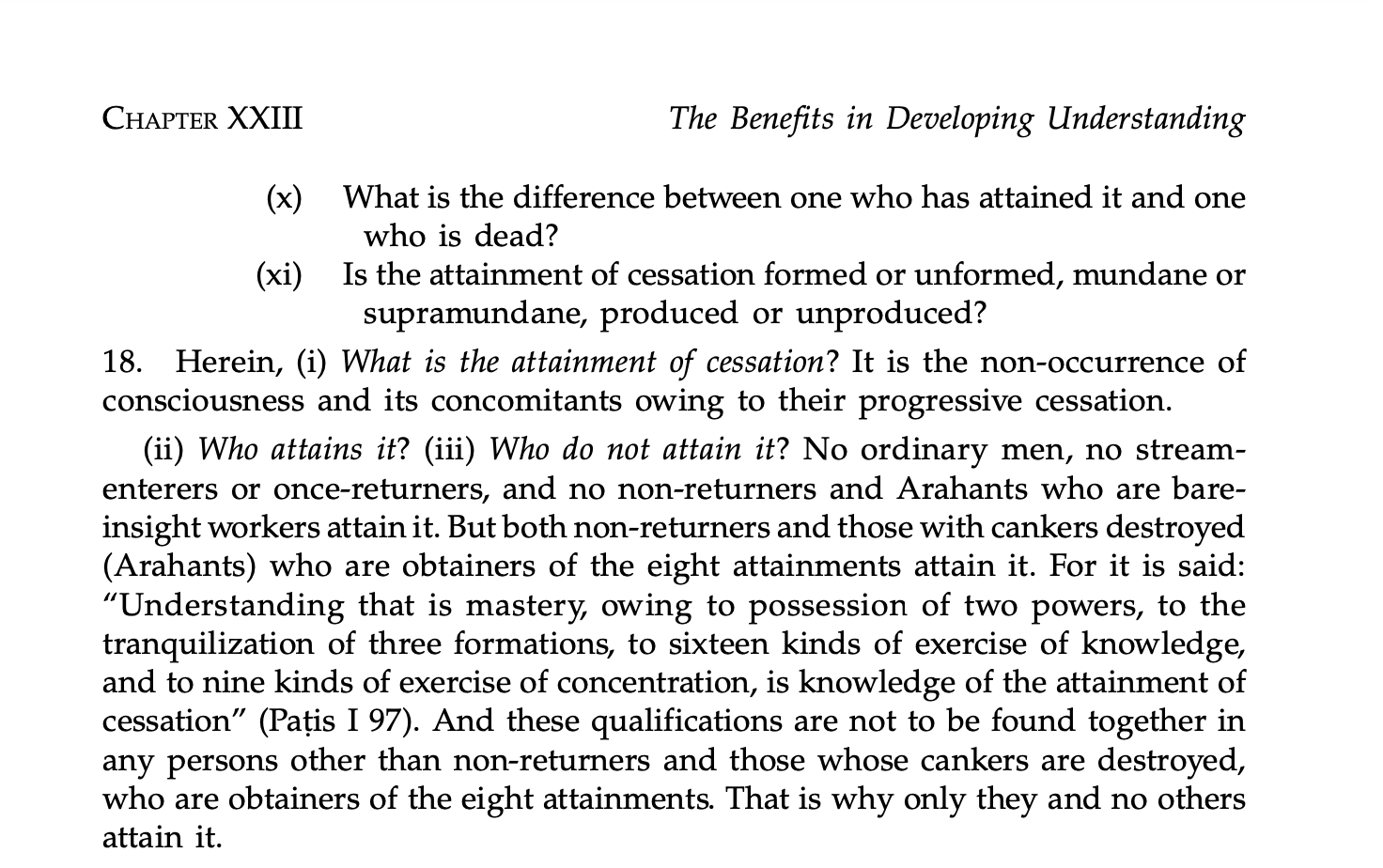
Thank you for sharing that discussion, Robert. There were some excellent points there made by Nina van Gorkom along with citations, including from the Commentaries.
It appears that only one who has attained nibbāna with mastery of jhāna can attain frution attainment.
It appears Bhikkhu Subhuti is wrong on this issue.
R
@renaldo Be careful. This is a super common litmus test. “Can you reach Nibbāna any time you want?” We get many people in the business who claim to be enlightened. This is a standard question we ask. There are many quotes too. You just have to use TPR ai Search.
tasmā sabbepi ariyā attano attano phalaṃ samāpajjantīti niṭṭhamettha gantabbaṃ.
Therefore, it should be concluded here that all noble ones attain their own respective fruit.
It is confused and a 1-off interpretation: I pasted the quote by Robert to gemini. It recognized this and confirmed that all ariya can attain. Below is what it said. It also knew it was from Sujin who was famous for this type of quote. In other words, you should be very careful to take a one-off interpretable tika quote that is interpreted to go against the upper level commentary.
- The Mahānāma Sutta Argument: The text cites the Aṅguttara Nikāya (AN 6.10), where Mahānāma (a stream-enterer) asks the Buddha how he should abide. The Buddha tells him to abide in the Six Recollections (Recollection of the Buddha, Dhamma, Saṅgha, etc.). The authors of the bulletin infer that if Mahānāma could simply enter Nibbāna via phala-samāpatti, the Buddha would have told him to do that. Because Mahānāma was a dry-insight worker, they argue he was limited to “access concentration” via recollections, rather than fruition.
- Reinterpreting the Visuddhimagga: To address the Visuddhimagga’s explicit statement that “all ariyans can enter,” this group argues that the passage is being taken out of context. They lean on sub-commentaries (like the Saddhammappakāsinī) to argue that “all” really meant “all those who have the prerequisite jhāna attainments,” strictly refuting the idea that phala-samāpatti is inherently available to everyone.
We have to be very careful when reading sub-commentary and not be a scholar.
Here is a long and actual quote from paṭisambhidāmaggaaṭṭhakathā ¶
paṭisambhidāmaggaaṭṭhakathā ¶
ke taṃ samāpajjanti?
Who attain it?ke na samāpajjantīti?
Who do not attain it?sabbepi puthujjanā na samāpajjanti.
All ordinary people do not attain it.kasmā?
Why?anadhigatattā.
Because it has not been realized.ariyā pana sabbepi samāpajjanti.
But all noble ones attain it.247kasmā?
Why?adhigatattā.
Because it has been realized.uparimā pana heṭṭhimaṃ na samāpajjanti puggalantarabhāvūpagamanena paṭippassaddhattā, heṭṭhimā ca uparimaṃ anadhigatattā.
However, those of higher stages do not attain the lower stages, as the lower stages have been appeased by their attainment of a different individual state; and those of lower stages do not attain the higher stages, as they have not yet realized them.attano attanoyeva pana phalaṃ sabbepi samāpajjantīti idamettha sanniṭṭhānaṃ.
Herein, the conclusion is that all noble ones attain their own respective fruit.keci pana ‘‘sotāpannasakadāgāminopi na samāpajjanti, uparimā dveyeva samāpajjantī’’ti vadanti.
Some say, however, that even stream-enterers and once-returners do not attain it; only the two higher ones attain it.idañca nesaṃ kāraṇaṃ – ete hi samādhismiṃ paripūrakārinoti.
And this is their reason: for these are fully accomplished in samādhi.taṃ puthujjanassāpi attanā paṭiladdhaṃ lokiyasamādhiṃ samāpajjanato akāraṇameva.
That is indeed no reason, for even an ordinary person attains the mundane samādhi that he has gained.kiñcettha kāraṇākāraṇacintāya.
What is the point of considering reasons and non-reasons here?nanu idheva pāḷiyaṃ ‘‘katame dasa saṅkhārupekkhā vipassanāvasena uppajjanti, katame dasa gotrabhudhammā vipassanāvasena uppajjantī’’ti (paṭi. ma. 1.60) imesaṃ pañhānaṃ vissajjane ‘‘sotāpattiphalasamāpattatthāya sakadāgāmiphalasamāpattatthāyā’’ti (paṭi. ma. 1.60) visuṃ visuṃ vuttā.
Are not the questions, “Which ten saṅkhārupekkhā arise by way of vipassanā, which ten gotrabhū-dhamma arise by way of vipassanā?” answered right here in the Pāḷi by stating separately “for the attainment of stream-entry fruit-attainment, for the attainment of once-returner fruit-attainment”?tasmā sabbepi ariyā attano attano phalaṃ samāpajjantīti niṭṭhamettha gantabbaṃ.
Therefore, it should be concluded here that all noble ones attain their own respective fruit.kasmā samāpajjantīti?
Why do they attain it?diṭṭhadhammasukhavihāratthaṃ.
For a happy abiding in this very life.yathā hi rājāno rajjasukhaṃ, devatā dibbasukhamanubhavanti, evaṃ ariyā ‘‘lokuttarasukhaṃ anubhavissāmā’’ti addhānaparicchedaṃ katvā icchiticchitakkhaṇe phalasamāpattiṃ samāpajjanti.
Just as kings experience the happiness of kingship, and devas experience divine happiness, so too, the noble ones, having determined a period of time, attain fruit-attainment at the desired moment, thinking, “We shall experience supramundane happiness.”