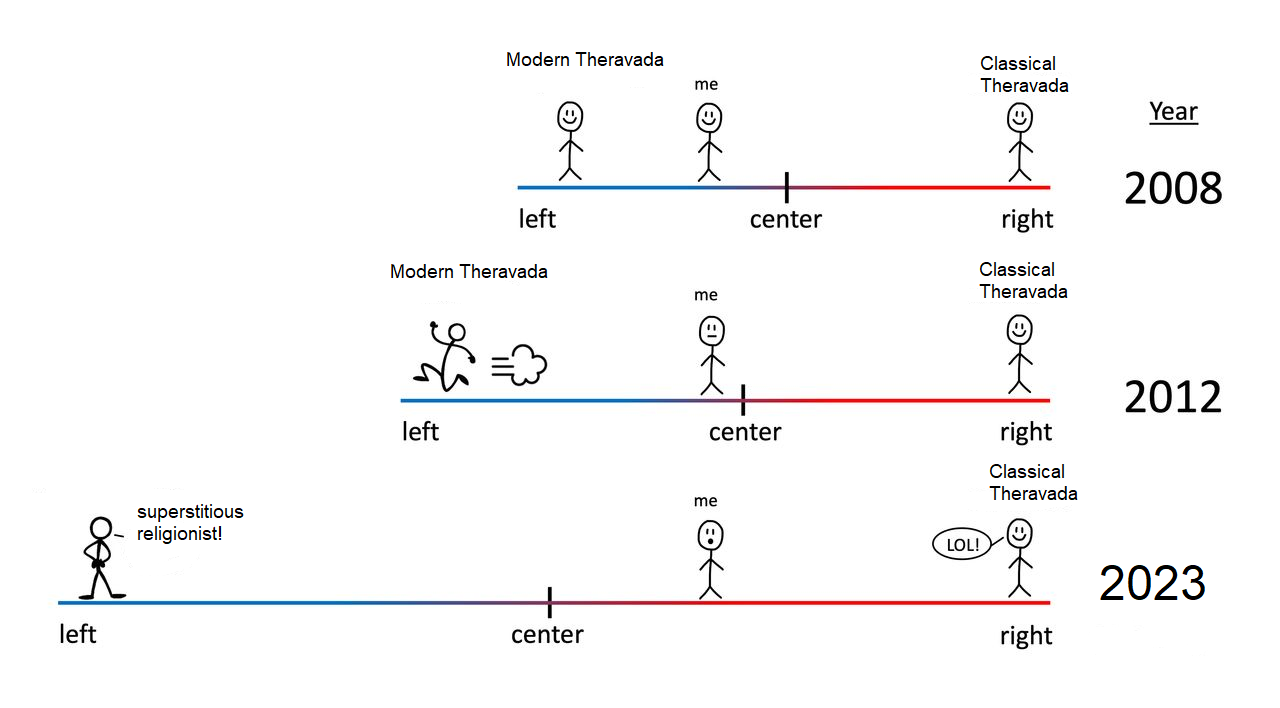
Has Modern Theravada become rebirth denial, i.e., secular buddhism? I see posts from members at DW who deny the rebirth teachings of the Buddha. I know EBT monks like Sujato and Brahmali accept (literal) rebirth, as do most monastics, but among the lay people it appears secular buddhism in increasing in popularity. Or is it just that these members post frequently and give the appearance that it is increasing in popularity?
So just for fun, I borrowed Elon Musk’s meme (his was on politics) to adapt to my position possibly changing due to this shift in the goalposts.
I think there probably have been some real changes. The meme is actually an excellent analogy. Similar to how political views change over time (the original meme), the same goes with religion. And just like liberalism, which is more dynamic in its values than the more static conservatism, modern theravada is more susceptible to changes than classical theravada.
Modern Theravada is based on this notion that what is preserved in Theravada contains a lot of inaccuracies, and that modern scholars must weed out the added superstition to get to “early Buddhism”. However, what is “additional stuff” is very subjective, and most people insert thier own modern values/beliefs into the equation when deciding whats an addition or not.
An example of this. The 8 Garudhammas are found in basically every version of the texts, so it meets the EBT criteria as probably legit. Yet modern scholars largely reject it, mostly because it contradicts thier own confirmation biases about womens equality that we have in the modern world. However, if scholars looked at it 200 years ago, or even 100 years ago, when women just barely got the right to vote. Everyone would look at it and be like, oh yeah, that makes sense given the time and place the Buddha was living in.
Because modern Theravada is based on rejecting certain texts/beliefs based on subjective criteria, what is rejected will change along with people’s ever changing beliefs and values. As the world came to value gender equality more, the seemingly sexist remarks made by the Buddha were rejected as fake even tho they made perfect sense given his time period. In the same way, as the world becomes more scientifically oriented and secular, its inevitable modern theravadins will move toward rejecting things that dont align with thier pre-existing beliefs like devas and rebirth.
TBH, with the rise of anti-caste discrimination laws in the West. I wouldnt be shocked of modern Theravadins eventually start anachronistically rejecting texts about the Buddha saying the warrior caste is higher than the brahmin caste or pali blessings that say stuff like “may you be reborn into a high caste” or ideas that caste is the result of karma, rather than simply accepting that the values/beliefs of 2040 AD America or whatever are not the ultimate value system of all of existence and that you have to contextualize the different values found in 500 BC rather than saying texts that dont align with your modern values are fake.
It is a shame that we need to name Theravāda as Classical Theravāda, but that is what we did and needed to do. Orthodox Theravāda might have been better in hindsight.
Ironic as it sounds… EBT is a modern invention despite it implying it is older. The followers pick and choose what they think is right or wrong and real or fake. I recently made a video about Real Theravāda (not published yet). At the end I explain that EBT and Suttanta are not real Theravāda. I also noted that “Bhikkhunis” are also EBT because they do the same type of “selective” Buddhism.
Yes, I agree with you; secular buddhism should not be called Buddhism. It is so far removed from the Dhamma that it should not be called Buddhism. It is just that they are small in numbers, but very loud, sometimes giving the impression that it is more popular than it really is.
Those from Western nations who become interested in Buddhism seem to have the most difficulty in understanding or accepting rebirth. Those from Asia don’t appear to have as much difficulty with it.
Good essay you wrote on the evolution of Buddhism.
If there is a most grotesque distortion of Buddhism, it is the so-called trend of “Secular Buddhism”—a mutation that bears no relation to Buddhism, neither from a distance nor up close.
At least there is classicaltheravada.org available for those who want to find it. Actually, Theravāda was always difficult to find and always needed to be sifted through in order to find it. In the 90’s it was all Mahayana.
Eastern Philosophy was a single shelf in the Mega Bookstores before the popular books only Amazon. You had only a few choices of Theravāda and what you called Theravāda was very loose because it was all you could get back then. You pretty much had the Middle and Long length discourses, Dhammapada and What the Buddha Taught. The rest was Tibetan, Mahayana and Zen which shared the same book case as yoga, Hinduism, and Tao. It was all on the same bookcase. Adi Da or Bubba Free John was just a few books away on the same shelf. Be here now was also on the same shelf. Krishnamurti and Paramahansa Yogananda were quite popular and also on the same shelf. All of “Eastern Philosophy” was a small collection and just a few books on Theravāda. The Middle Length Discourses was very expensive for that time too. If you were lucky, you found accesstoiinsight.org in the late 90’s. That was a goldmine back then. Ajahn Thanissaro was the only available translator for free back then. Those who found Pa-Auk in my time and especially before were pioneers. For our own @RobertK to get involved with the Abhidhamma as early as he did shows lots of parami. He is the owner of abhidhamma.org which shows his early adoption. (The website is quite modern now.. take a look).
To persecute or cancel people due to such beliefs is not really what the Buddha did. The Buddha was primarily interested in people practicing morals & dispassion. There is a sutta where the Buddha praised the annihilationist doctrine as the most superior of outsider doctrines because he said the annihilationist doctrine can lead to dispassion.
The Sri Lanka monk in the post has the idea: “As Buddha taught Kamma / Vipaka is the Lokiya Sammaditthi (worldly right view)”. This view is supported somewhat by the MN 117, which says:
There is right view that is accompanied by defilements, partakes of good deeds, and ripens in attachments… There are fruits and results of good and bad deeds (kammānaṁ phalaṁ vipāko)… MN 117
There are as many suttas about ‘rebirth’ as there are suttas with the Buddha dismissing obsessions with ‘rebirth’ (such as MN 79). The primary Dhamma the Buddha exhorted was the Dhamma that is directly visible in the here & now, which is how the Buddha literally defined his Dhamma. The Dhamma Refuge is the visible here & now Dhamma.
I think the problem here is not people having different views about Buddhism but, instead, the unwillingness of others to listen to their views; particularly not listening to their views when their views are supported by Sutta.
There is no evidence in the Suttas the Buddha had the attitude to persecute, cancel or alienate people who did not believe in ‘rebirth’.
I doubt this ‘non-rebirth’ is exclusively a Western matter. What the Western matter appears to be is:
Religious fundamentalism from Biblical influence asserting itself into Western Buddhism
Religious evangelism or identity salvation doctrine from Biblical influence asserting itself into Western Buddhism. I myself have noticed a tendency by Western Buddhists to believe simply because they believe & promote rebirth they will be guaranteed a good rebirth.
Yes, the goal posts have certainly moved. There are Western monks and Western laypeople on the internet with openly highly questionable political adherences (even manufacturing Buddhist doctrines of ‘Just War’) heavily pushing Buddhist rebirth belief. This is what is very strange. My personal sense is any bhikkhu formulating a doctrine of Just War is surely close to Parajika.
The view that beings are annihilated after the death of the material body—such that they cease to exist—is strongly criticized by the Buddha. The annihilationist view that the Buddha praises, according to AN10.29 Paṭhamakosalasutta is the one that upholds the total destruction of the being as the result of spiritual practice.
People attached to such ideas do not reject the view of rebirth nor the view that good and bad actions have consequences. They might engage in the performance of meritorious deeds or the cultivation of jhānas to attain that goal.
There are six variations of this praiseworthy annihilationist belief, according to DN 1: Brahmajāla Sutta:
annihilation after living for some time as a deva;
annihilation after living for some time as a Brahmā in the form realm;
and four more variations corresponding to the formless realms in which one is reborn:
after rebirth in the realm of infinite space (ākāsānañcāyatana),
after rebirth in the realm of infinite consciousness (viññāṇañcāyatana),
after rebirth in the realm of nothingness (ākiñcaññāyatana),
after rebirth in the realm of neither perception nor non-perception (nevasaññānāsaññāyatana).
The Buddha rebuked wrong views all the time. He rebuked foolish people and foolish teachings.
The 6 Heretical teachers and teachings include four or five teachings which could be called secular Buddhism in today’s world. They outright deny rebirth or imply no rebirth. The Buddha called them heretical.
And I am not persecuting or canceling anyone; I was just referring to the goalposts and where my position is. Anyone else can be at another position and I am not telling anyone else what to do.
This is the part of that sutta that I guess focuses on the view of outsiders that is close…
AN 10.29 Paṭhamakosalasutta:
“This is the highest of the views held by outsiders: ‘This is not mine, this I am not, this is not my self.’ When someone holds this view, it can be expected that they will be repelled by craving for existence and will not be repelled by the cessation of existence (bhava). This is the highest of the views held by outsiders.”
bhavataṇhā : craving for becoming, desire for existence.
Translation Note: This translation was made in collaboration with xAI. It uses my own personal glossary, greatly leaning on Bhikkhu Bodhi’s glossary, and heavly leaning on the Pali-English Dictionary (PED).
Of course, as already discussed, Rebirth is central to the Dhamma. In fact there would be little reason to try and get out of samsara if there were no rebirth. There would be no Buddhas perfecting themselves for trillions of universe cycles. I really don’t understand how they can hold such views.
Dangers of changing the Dhamma
“… The snake would turn back and bite him, causing death or deadly pain.
Why? Because of his wrong grasp of the snake.
So too, some misguided man learns the Dhamma—suttas, chants, analyses, verses, inspired sayings, sayings, birth stories, marvels, and question & answers—but having learned the Dhamma, he does not investigate the meaning of those Teachings with wisdom. Not investigating the meaning with wisdom, he does not attain a reasoned acceptance of them. Instead, he learns the Dhamma for the purpose of finding fault or winning arguments, and he does not realize the goal (attha) for which the Dhamma is learned. Those tTeachings, wrongly grasped by him, lead to his harm (anaya) and suffering (dukkha) for a long time.”
— Alagaddūpama Sutta (MN 22.10)
On Rebirth in Right View; Sammādiṭṭhi Sutta
“When a noble disciple fully comprehends birth, its arising, its ceasing, and the path to its ceasing, he possesses right vision, his view is straight, he has complete trust in the Dhamma, and has attained this true Dhamma.” (MN 9.25)
“Birth is the arising of beings in various realms, their generation, entry into a womb, manifestation of aggregates, acquisition of sense-bases. Birth arises from the arising of becoming. Birth ceases with the ceasing of becoming. The path to the ceasing of birth is the noble eightfold path.” (MN 9.26)
PED: jāti: birth, production, jāti-samudaya: arising of birth, jāti-nirodha: ceasing of birth, bhava: becoming, existence, bhava-samudaya: arising of becoming, bhava-nirodha: ceasing of becoming, khandhānaṃ pātubhāvo: manifestation of aggregates.
Yama on Hell obvious Rebirth
“You did evil by yourself, not by mother, not by father, not by brother, not by friends, not by kin, not by others. That evil deed, done by you, must be reaped. You did not do good, did not amass merit, did not act wisely; now you go to the great ruin, the hell realms, to face suffering.” (PTS Majjhima Nikāya Vol. III, p. 182, MN 130 )
The Fruits of Recluseship: The Sāmaññaphala Sutta and Its Commentaries
“By this recollection of past lives, he understands the round of existence and how to bring it to an end.” (Bhikkhu Bodhi, p. 162)
“He recollects his manifold past lives, that is, one birth, two births, three births, four births, five births, ten births, a hundred births, a thousand births, many aeons of birth and rebirth, thus: ‘There I was, such was my name, such my clan, such my appearance, such my food, such my experience of pleasure and pain, such my life’s end; passing away from there, I was reborn here.’” (PTS Dīgha Nikāya Vol. I, p. 81)
“By this recollection of past lives, he discerns the cycle of birth and rebirth and the means to its cessation.” (p. 81)
“He sees beings passing away and being reborn, inferior and superior, fair and ugly, fortunate and unfortunate, and he understands how beings fare according to their deeds.” (p. 82)
“With the divine eye, purified and surpassing the human, he sees beings passing away and being reborn, and he knows: ‘These beings, due to evil conduct in body, speech, and mind, are reborn in a state of misery, in hell.’” (p. 82)
“He understands thus: ‘Birth is ended, the holy life is fulfilled, what had to be done has been done, there is no more coming back to any state of being.’” (p. 83)
PED: jāti: birth, production, pubbenivāsānussati: recollection of past lives.
Commentary - Papañcasūdanī, Buddhaghosa
PTS Papañcasūdanī Vol. I, p. 255 - 261.
“Birth (jāti) is the production of beings in diverse realms of existence (sattānaṃ tathā tathā sattesu jāti), their arising, rooted in the process of becoming (bhava).”
“The arising of birth (jāti-samudaya) is due to the arising of becoming (bhava-samudayo), which is existence conditioned by kamma, stemming from craving (taṇhā-mūlaka) and ignorance (avijjā-mūlaka).”
“Through recollection of past lives (pubbenivāsānussati), he perceives the arising of beings by birth (jāti) in various realms, conditioned by kamma, and understands the cessation of birth (jāti-nirodha) via the noble eightfold path, freeing him from the cycle of rebirth (saṃsāra).”
“The cycle of rebirth (saṃsāra) is the continuous arising of birth (jāti) due to kamma, seen in manifold past lives, leading to states of woe or bliss.”
“By the divine eye (dibbacakkhu), he discerns beings reborn (upapanna) in diverse realms, from hell (niraya) to divine states, according to their kamma, and thus knows the round of birth (jāti-saṃsāra).”
“The knowledge of the destruction of the cankers (āsavakkhaya-ñāṇa) understands: ‘Birth (jāti) is destroyed, there is no further arising in any realm of existence (saṃsāra).’”
I see that you need to stop rushing into making statements—especially since you evidently know nothing about the one you’re talking about and are speaking with little discernment.
“Since there actually is another world, one who holds the view ‘there is no other world’ has wrong view. Since there actually is another world, one who intends ‘there is no other world’ has wrong intention. Since there actually is another world, one who makes the statement ‘there is no other world’ has wrong speech. Since there actually is another world, one who says ‘there is no other world’ is opposed to those arahants who know the other world. Since there actually is another world, one who convinces another ‘there is no other world’ convinces him to accept an untrue Dhamma; and because he convinces another to accept an untrue Dhamma, he praises himself and disparages others. Thus any pure virtue that he formerly had is abandoned and corrupt conduct is substituted. And this wrong view, wrong intention, wrong speech, opposition to noble ones, convincing another to accept an untrue Dhamma, and self-praise and disparagement of others—these several evil unwholesome states thus come into being with wrong view as their condition.
Being praised as the “best of the outsiders” is not truly a compliment. No matter how far an outsider progresses, they remain in an inferior position compared to someone who is on the path to becoming a noble one (ariya). Furthermore, the outsiders mentioned in AN10.29 Paṭhamakosalasutta do not deny rebirth; rather, they strive to overcome it.
Speaking about the disadvantages of rebirth is not the same as rejecting the reality of rebirth altogether. The Buddha clearly included rebirth as part of Right View and criticized teachers who denied it.
One such teacher was Ajita of the Hair Blanket. His doctrine is presented in the suttas as harmful to the spiritual life. MN76 Sandakasutta describes his view as follows:
'This person is made up of the four principal states [the Four Elements]. When they die, the earth in their body merges and coalesces with the substance of earth. The water in their body merges and coalesces with the substance of water. The fire in their body merges and coalesces with the substance of fire. The air in their body merges and coalesces with the substance of air. The faculties are transferred to space. Four men with a bier carry away the corpse. Their footprints show the way to the cemetery. The bones become bleached. Offerings dedicated to the gods end in ashes. Giving is a doctrine of morons. When anyone affirms a positive teaching it’s just hollow, false nonsense. Both the foolish and the astute are annihilated and destroyed when their body breaks up, and they don’t exist after death.’
(…)
This is the first way that negates the spiritual life.