Dana - giving

vacchagotta

  • Aṅguttara Nikāya
  • The Book of the Threes

3.57. Vaccha

Then the wanderer Vacchagotta approached the Blessed One … and said to him:

“Master Gotama, I have heard: ‘The ascetic Gotama says: “Alms should be given only to me, not to others; alms should be given only to my disciples, not to the disciples of others. Only what is given to me is very fruitful, not what is given to others; only what is given to my disciples is very fruitful, not what is given to the disciples of others.”’ Do those who speak thus state what has been said by Master Gotama and not misrepresent him with what is contrary to fact? Do they explain in accordance with the Dhamma so that they would not incur any reasonable criticism or ground for censure? For we do not want to misrepresent Master Gotama.”

“Those, Vaccha, who say: ‘The ascetic Gotama says: “Alms should be given only to me … only what is given to my disciples is very fruitful, not what is given to the disciples of others,”’ do not state what has been said by me but misrepresent me with what is untrue and contrary to fact. One who prevents another from giving alms creates an obstruction and stumbling block for three people. What three? He creates an obstruction to the donor’s acquiring merit, to the recipients’ gaining a gift, and already he has maimed and injured himself. One who prevents another from giving alms creates an obstruction and stumbling block for these three people.

“But, Vaccha, I say that one acquires merit even if one throws away dishwashing water in a refuse dump or cesspit with the thought: ‘May the living beings here sustain themselves with this!’ How much more, then, does one acquire merit when one gives to human beings! However, I say that what is given to one of virtuous behavior is more fruitful than what is given to an immoral person. And the most worthy recipient is one who has abandoned five factors and possesses five factors.

“What five factors has he abandoned? Sensual desire, ill will, dullness and drowsiness, restlessness and remorse, and doubt. These are the five factors that he has abandoned.

“And what five factors does he possess? The virtuous behavior, concentration, wisdom, liberation, and knowledge and vision of liberation of one beyond training. These are the five factors that he possesses.

“It is in such a way, I say, that what is given to one who has abandoned five factors and possesses five factors is very fruitful.”

Among cattle of any sort,
whether black, white, red, or golden,
mottled, uniform, or pigeon-colored,
the tamed bull is born,
the one that can bear the load,
possessing strength, advancing with good speed.
They yoke the burden just to him;
they are not concerned about his color.

So too, among human beings
it is in any kind of birth—
among khattiyas, brahmins, vessas,
suddas, caṇḍālas, or scavengers—
among people of any sort
that the tamed person of good manners is born:
one firm in Dhamma, virtuous in conduct,
truthful in speech, endowed with moral shame;
one who has abandoned birth and death,
consummate in the spiritual life,
with the burden dropped, detached,
who has done his task, free of taints;
who has gone beyond all things of the world
and by non-clinging has reached nibbāna:
an offering is truly vast
when planted in that spotless field.

Fools devoid of understanding,
dull-witted, unlearned,
do not attend on the holy ones
but give their gifts to those outside.
Those, however, who attend on the holy ones,
on the wise ones esteemed as sagely,
and those whose faith in the Fortunate One
is deeply rooted and well established,
go to the world of the devas
or are born here in a good family.
Advancing in successive steps,
those wise ones attain nibbāna.

2 Likes
  • Numbered Discourses 5.148
    1. At Tikaṇḍakī

#Gifts of a True Person

“There are these five gifts of a true person. What five? They give a gift out of faith. They give a gift carefully. They give a gift at the right time. They give a gift with no strings attached. They give a gift without damaging themselves or others.

Having given a gift out of faith, in whatever place the result of that gift manifests they become rich, affluent, and wealthy. And they’re attractive, good-looking, lovely, of surpassing beauty.

Having given a gift carefully, in whatever place the result of that gift manifests they become rich, affluent, and wealthy. And their children, wives, bondservants, servants, and workers want to listen. They actively listen and try to understand.

Having given a gift at the right time, in whatever place the result of that gift manifests they become rich, affluent, and wealthy. And when the time is right, their needs are amply satisfied.

Having given a gift with no strings attached, in whatever place the result of that gift manifests they become rich, affluent, and wealthy. And their mind tends to enjoy the five refined kinds of sensual stimulation.

Having given a gift without damaging themselves or others, in whatever place the result of that gift manifests they become rich, affluent, and wealthy. And no damage comes to their property from anywhere, whether fire, flood, rulers, bandits, or unloved heirs.

These are the five gifts of a true person.”

1 Like

I recently redid my website and also have short videos. (part of the reason why I’m not so active these days).

Three videos below: 2 by me (very short) and one by Ven Bodhi (longer).

and this one:

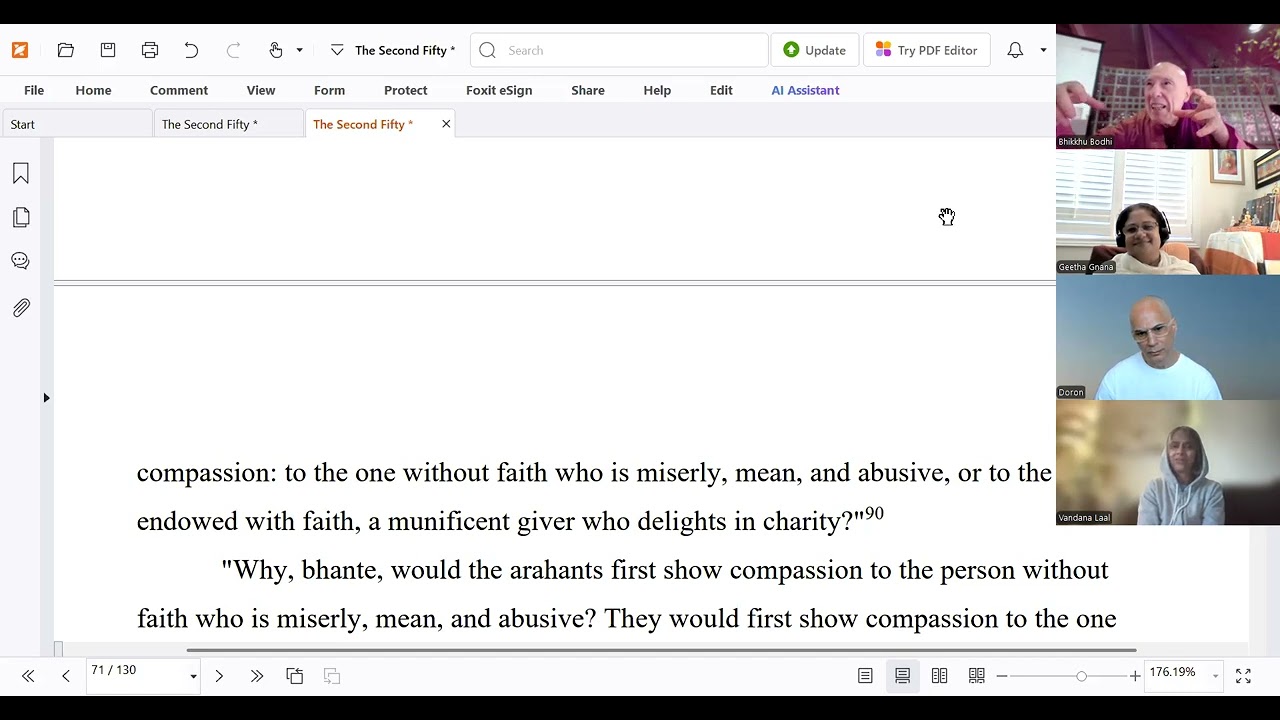
Ven Bodhi recently had a nice video if you have time to watch. The comment he made about going for alms is 100% accurate from my view:

1 Like

Perfections: Sujin Boriharnwanaket

The perfection of generosity is mentioned first among the ten
perfections. As we read in the definition of dåna, given by the
Commentary to the “Basket of Conduct”:
Giving (dåna) has the characteristic of relinquishing; its function is to dispel greed for things that can be given away; its manifestation is nonattachment, or the achievement of prosperity and a favourable state of existence; an object that can be relinquished is its proximate cause.”
Most people know that generosity is the giving away of things for the
benefit and happiness of others. Laypeople cannot give away all their
possessions because they still cling to sense objects, but when there is
an opportunity for generosity they should practise it. If one is unable to
give away something one possesses, be it small or great, for the benefit
of others, it will be so much harder to give up the clinging and
attachment to the nåma dhammas and rúpa dhammas one takes for
self, beings and persons.
Therefore, it is necessary to give away things for the benefit and
happiness of others as much as one is able to, in order to eliminate
defilements, including attachment to possessions as well as clinging to
nåma dhammas and rúpa dhammas one takes for beings, people and
self. Thus, in our daily life we should not neglect the development of
the perfection of generosity.

1 Like

anguttara nikaya 8

33 (3) Grounds
“Bhikkhus, there are these eight grounds for giving.1700 What eight? (1) One gives a gift from desire. (2) One gives a gift from hatred. (3) One gives a gift from delusion. (4) One gives a gift from fear.1701 (5) One gives a gift, [thinking]: ‘Giving was practiced before by my father and forefathers; I should not abandon this ancient family custom.’ (6) One gives a gift, [thinking]: ‘Having given this gift, with the breakup of the body, after death, I will be reborn in a good destination, in a heavenly world.’ (7) One gives a gift, [thinking]: ‘When I am giving this gift my mind becomes placid, [237] and elation and joy arise.’ (8) One gives a gift for the purpose of ornamenting the mind, equipping the mind. These are the eight grounds for giving.

31 (1) Giving (1)
“Bhikkhus, there are these eight gifts. What eight? (1) Having insulted [the recipient], one gives a gift.(2) One gives a gift from fear. (3) One gives a gift, [thinking]: ‘He gave to me.’ (4) One gives a gift, [thinking]: ‘He will give to me.’ (5) One gives a gift, [thinking]: ‘Giving is good.’ (6) One gives a gift, [thinking]: ‘I cook; these people do not cook. It isn’t right that I who cook should not give to those who do not cook.’ (7) One gives a gift, [thinking]: ‘Because I have given this gift, I will gain a good reputation.’ (8) One gives a gift for the purpose of ornamenting the mind, equipping the mind.”1698

Commentary :

Bhikkhu Bodhi note 1698 Mp: “For the purpose of ornamenting and equipping the mind with serenity and insight.”

1 Like