I’m feeling a bit discouraged because I don’t know if there is anyone who can guarantee that enlightenment is still possible in this era. Is there any meditation teacher (lay person or a monk) who can confidently say “I have realized the path and fruit knowledge. Practice this method that I’ve practiced”? I don’t know how we can know for sure which meditation master we should practice under if they don’t claim with certainty that they have realized the Dhamma. In the past, the Buddha was able to declare, with full confidence, that He is a Buddha and has attained the end of suffering, so people practiced under Him because they knew enlightenment could be attained. Nowadays, I don’t know if there is anyone to serve as a living example that enlightenment is still possible in this time and age.
You can get many people who will say this to you. Monks are not allowed to declare their own attainments to lay people. But let’s suppose they could. Just like Daniel Ingram, they can say what they believe, but we cannot know for sure.
We need to look at them, but even so, it is difficult to judge.
A once returner remained married and appeared to be showing affection.
2. migasālāsuttaṃ
‘‘ tatrānanda, pamāṇikā pamiṇanti –
“In this case, Ānanda, the discerning ones make a judgment –
‘ imassapi teva dhammā, aparassapi teva dhammā.
‘This one has the same qualities as the other.
kasmā tesaṃ eko hīno, eko paṇīto ’ ti?
Why is one inferior, and one superior?’”
tañhi tesaṃ, ānanda, hoti dīgharattaṃ ahitāya dukkhāya.
Indeed, Ānanda, that will be for their lasting harm and suffering.
‘‘ tatrānanda, yassa puggalassa kodhamāno adhigato hoti, samayena samayañcassa vacīsaṅkhārā uppajjanti, tassa savanenapi kataṃ hoti, bāhusaccenapi kataṃ hoti, diṭṭhiyāpi paṭividdhaṃ hoti, sāmāyikampi vimuttiṃ labhati.
“In this case, Ānanda, the individual in whom anger and conceit are found, and in whom from time to time verbal formations arise, for whom, by hearing, it is accomplished; by much learning, it is accomplished; by insight, it is penetrated; he attains temporary liberation.
ayaṃ, ānanda, puggalo amunā purimena puggalena abhikkantataro ca paṇītataro ca.
This individual, Ānanda, is more excellent and more sublime than that former individual.
taṃ kissa hetu?
For what reason?
imaṃ hānanda, puggalaṃ dhammasoto nibbahati.
This individual, Ānanda, is carried along by the stream of the Dhamma.
tadantaraṃ ko jāneyya aññatra tathāgatena!
But who can know that difference, apart from a Tathāgata?
tasmātihānanda, mā puggalesu pamāṇikā ahuvattha;
Therefore, Ānanda, do not be discerning regarding individuals;
mā puggalesu pamāṇaṃ gaṇhittha.
do not pass judgment on individuals.
khaññati hānanda, puggalesu pamāṇaṃ gaṇhanto.
Indeed, Ānanda, one who passes judgment on individuals is harmed.
ahaṃ vā, ānanda, puggalesu pamāṇaṃ gaṇheyyaṃ, yo vā panassa mādiso.
I, Ānanda, or one like me, may pass judgment on individuals.
‘‘ kā cānanda, migasālā upāsikā bālā abyattā ammakā ammakasaññā, ke ca purisapuggalaparopariyañāṇe!
“Who, indeed, is the laywoman Migasālā, a foolish, incompetent woman with a woman’s intellect? And who are those [who have] knowledge of the individual persons [as superior and inferior]?
I would say take the Dhamma as your teacher:
“Ānanda, the Dhamma and Vinaya that I have taught and laid down for you will be your teacher after my passing.”
Yo vo, ānanda, mayā dhammo ca vinayo ca desito paññatto, so vo mamaccayena satthā
Much worse than these doubts you are having is deciding/hoping some modern teacher has attained and putting all your faith in them. If they have misunderstood then you will follow them down a wrong path.
Right at this moment the Dhamma is showing itself - the khandhas are here and now. Doubt is real, it can be understood as merely a conditioned element.
1 - Namarupa Pariccheda Nana is the first stage of insight. 16 stages of insight - Google Search.
Everyone can attain that level if try enough. As long as one can maintain this knowledge, the rest of one’s life, it is possible to attain the next stage.
The present era is regarded as a period of decline of the Buddha-sāsana, but that does not mean that reaching the goal has immediately become impossible. Despite the decline of the Sāsana, it has not yet disappeared; rather, this decline is followed and accompanied by a progressive weakening. Nevertheless, as long as the Sāsana and the conditions for practice endure, the possibility of attaining the supramundane paths remains. Thus, yes, it is still possible.
As for the second part of your question, attainments do stand on the Lord Buddha’s Dhammic discourse, with the practice that is integrated with it in order to realize the goal. The equation is thus, and it is not of the character that you are suggesting here in the form of:
Existence of a modern teacher → credible claim of realization → evidence that liberation remains possible
The Dhamma does not rely on contemporary claims in order to derive its validity from them. Even if someone appears who makes such a claim, proves it, and manifests it, this does not add anything to the Dhamma, because the Dhamma in itself is what it is: TRUTH.
Moreover, many people ask: Which teacher is qualified? Does his meditation lead to liberation? But the central question, in truth, and the one that should be asked in the first place, is: (1) Whether this teaching of the person (X) is in accordance with what the Theravāda teaches; (2) whether his meditation instructions are consistent with the canonical path; (3) whether he professes the true Creed; and so forth.
A Bhikkhu who violates this and claims whatever he wishes is no different from the other claimants among the dissenters of the other religions. Furthermore, you must distinguish between knowing and trusting. The better approach is careful investigation followed by confidence.
You said it yourself. It was The Lord Buddha who proclaimed the way to liberation, and that alone is sufficient for us as a rope to which we may hold fast.
Awakening is by no means an easy or simple matter; it is difficult and arduous. We live today in an age saturated with every conceivable form of temptation. There are sensual and bodily temptations, as well as mental and imaginative ones. These require only the slightest weakness in one’s resolve to draw him into a mire from which he may find himself unable to escape. We live today in an age rife with moral and spiritual degradation, and all these things are obstacles that place us in a difficult and precarious position.
There is an account which the Most Venerable Ācariya Buddhaghosa Mahāthera recounts concerning an Elder named Mahā Saṅgharakkhita, a revered and illustrious monk who was over sixty years of age and approaching death, who, having declared that he had attained no supramundane state, Another monk informed him of how great the disappointment would be among the many people who had come from distant places to see the Elder, believing him to have attained liberation. He remarked, after attaining the goal in the final moments and having been urged to make an effort in insight, that the truly difficult thing was not attaining the supramundane state at that point, but having lived his life from the time of his ordination without performing any action without mindfulness and clear awareness. See: (Vism. I.135; Ven. Bhk. Ñāṇamoli, trans.).
For the same account, you can consult:
The Most Ven. Mingun Sayadaw, The Great Chronicle of Buddhas, 1st ed., trans. U Ko Lay and U Tin Lwin, vol. 1, pt. 1 (Ti-Ni Publishing Centre, 1991), 206-207.
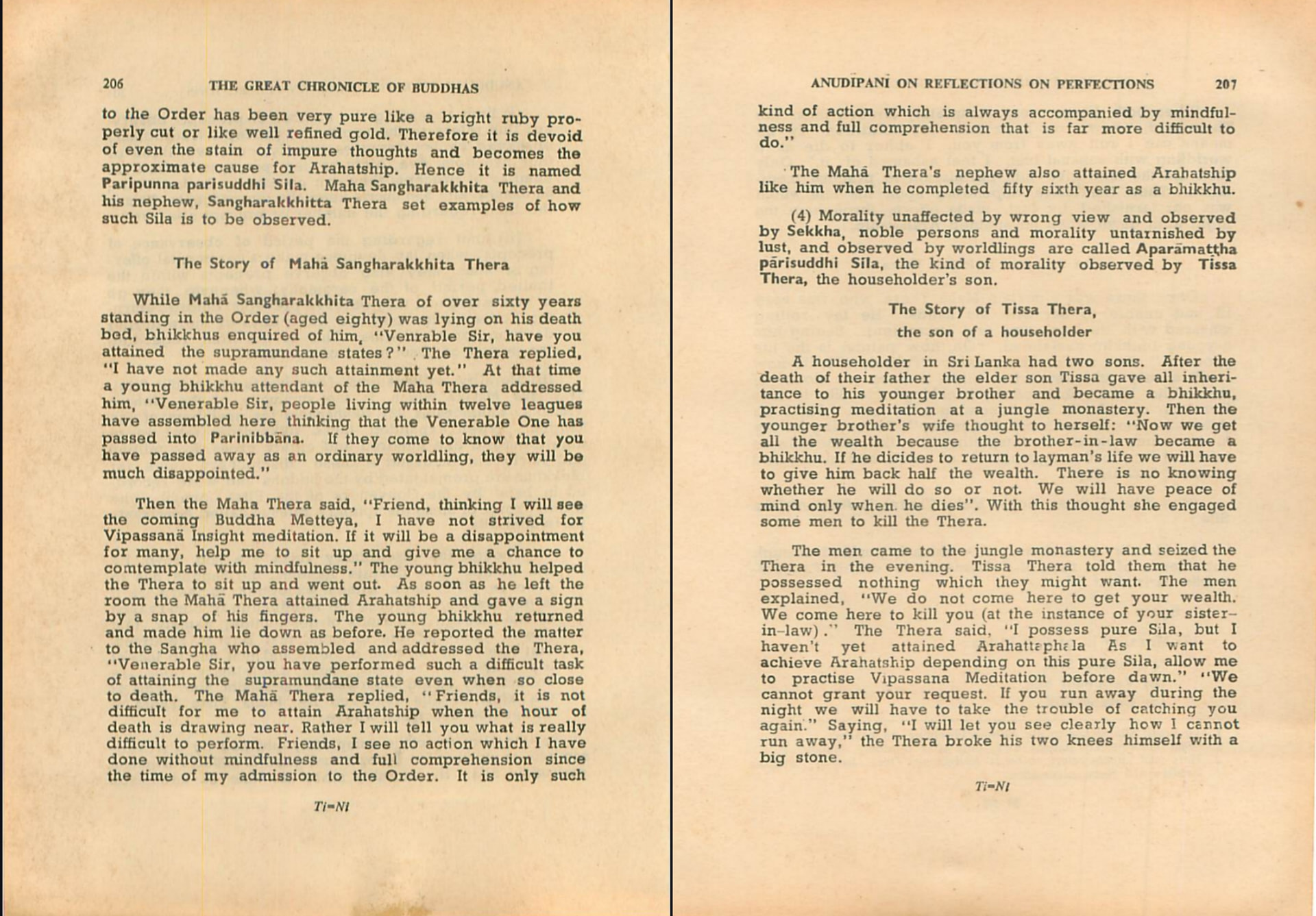
Do you see how the matter is not dependent upon the age in which one lives? Those who lived in ages past faced many difficulties, and indeed, we are not even of their stature. It may be said, to some extent, that their time was less tumultuous in the ordinary course of daily life than our own, but this does not alter the essential point. If the difficulties that surround us are to have any effect upon us, that effect ought to be to sharpen and strengthen one’s resolve. The path is long and arduous, but a firm resolve that does not break can never weaken or falter.
I am only a layperson, but have faithfully studied both major sects around in this age, with a personal preference for strict adherence to Orthodox Theravada. It is needed in this age so far away from the founder of this True teaching to be able to give up all attachments to the world we see around us. We must make the body bow down to the power of the Heart.
The mind that fully understands His teaching is not ever knowable by following logic when we think mainly with the brain. The uncorrupted that The Buddha talks about (Nibbana), is the driving force of the Heart based mind. Remember when The Buddha said that his teachings through speech or now written text can only point us to the “Moon,” since it truly isn’t something able to be comprehended until you are about to cross the river so to speak.
Once you feel like your ready to abandon his physical teaching we spent so much time trying to meditate and practice. You can let go and let both your spiritual mind living in the Heart and the physical mind tied to the senses, let go of the “raft” and finish the journey to the other shore.
Don’t take just my testimony for I would never be able to complete what I have without having full faith that The Buddha truly did know more that us that have come after him due to leaving the best life that could be had while on Earth to pursue spiritual peace, not just peace of the body. I feel like I can personally testify that He was the truly Self-enlightened one of His age in order to save his generation from the corruption’s he saw all over.