5 sense consciousness

Is there any perception at the stage of the bare 5 sense consciousness, at initial contact? I’m trying to understand this passage from the Abhidhamma in greater detail

The five types of sense consciousness are not cognitive” means: For the five types of sense consciousness there is no turning towards (the object) or cognition or advertence or attention.“By the five types of sense consciousness one discriminates no state whatever” means: By the five types of sense consciousness one discriminates no state whatever. “Other than mere falling in” means: Other than mere falling in (i.e., entry of the object). “Even immediately following the five types of sense consciousness one discriminates no state whatever” means: Immediately following the five types of sense consciousness one discriminates no state whatever, even by mind element. “By the five types of sense consciousness one makes no posture whatever” means: By the five types of sense consciousness one makes no posture whatever, either going, standing, sitting or lying. “Even immediately following the five types of sense consciousness one makes no posture whatever” means: Immediately following the five types of sense consciousness one makes no posture whatever, either going, standing, sitting or lying, even by mind element. “By the five types of sense consciousness one establishes no bodily action, no verbal action” means: By the five types of sense consciousness one establishes no bodily action, no verbal action. “Even immediately following the five types of sense consciousness one establishes no bodily action, no verbal action” means: Immediately following the five types of sense consciousness one establishes no bodily action, no verbal action, even by mind element. “By the five types of sense consciousness one performs no good or bad state” means: By the five types of sense consciousness one performs no good or bad state. “Even immediately following the five types of sense consciousness one performs no good or bad state” means: Immediately following the five types of sense consciousness one performs no good or bad state, even by mind element. “By the five types of sense consciousness one does not attain, does not emerge” means: By the five types of sense consciousness one does not attain, does not emerge. “Even immediately following the five types of sense consciousness one does not attain, does not emerge” means: Immediately following the five types of sense consciousness one does not attain, does not emerge, even by mind element. “By the five types of sense consciousness one does not pass away, does not arise” means: By the five types of sense consciousness one does not pass away, does not arise (i.e., is not reborn). “Even immediately following the five types of sense consciousness one does not pass away, does not arise” means: Immediately following the five types of sense consciousness one does not pass away, does not arise, even by mind element. “By the five types of sense consciousness one does not | sleep, does not wake, does not see dreams” means: By the five types of sense consciousness one does not sleep, does not wake, does not see dreams. “Even immediately following the five types of sense consciousness one does not sleep, does not wake, does not see dreams” means: Immediately following the five types of sense consciousness one does not sleep, does not wake, does not see dreams, even by mind element. Thus the explanation of the true nature of the basis (of knowledge) is wisdom. Thus is the basis of knowledge by way of singlefold division.
Vb 16: Ñāṇavibhaṅga—U Thittila

I understood it this way:

The citta that arises from contact at the sense bases contains only viññāṇa, vedanā, and saññā. Other mental factors—such as reflection on the object, intention, and craving—arise in subsequent cittas.

It is good to be precise here. Citta and viññāṇa are synonyms for the same reality:

Vism X1V, 82
” ‘Whatever has the characteristic of cognizing should be understood, all
taken together, as the consciousness aggregate’ was said above. And what
has the characteristic of cognizing (vijanana)? Consciousness
(vinnana); according as it is said, ‘It cognizes, friend, that is why
‘consciousness’ is said (M i 292). The words vinnana (consciousness),
citta (mind, consciousness), and mano (mind) are one in meaning.

Is viññāṇa always synonymous with citta? Are saṅkhāra, vedanā, and saññā considered cetasikas? Also, has the understanding I shared—after correcting the terminology—been helpful to you in any way?

Generally viññāṇa, citta and mana are aññamaññavevacana.

Especially if used to diffentiate one dhamma among a group of dhammas.

For example citta(mano, vinnana) amongst all sampayutta dhammas in a cittuppada, viññāṇakkhandha amongst pancakkhandha, manāyatana amongst saḷāyatana.

1 Like

Good to see this passage from the Abhidhamma quoted. It is terse and the English wording is a little difficult. It could benefit from a great translator like Bhikkhu Bodhi giving notes on sections and words to clarify each passage.

Anyway:
At the moment of one of the 5 sense door consciousness there is only seeing or only hearing etc. Those exceedingly brief moments arise as one instant during a sense door process. As @Brunobm noted that moment has only a limited number of cetasikas associated with it: i.e. the seven universals (sabbacittasādhāraṇa). Phassa (contact); Vedanā (feeling); Saññā (perception); Cetanā (volition); Ekaggatā (one-pointedness / concentration)
Jīvitindriya (life faculty, mental) and Manasikāra (attention).

These five sense-consciousness cittas are ahetuka vipāka cittas (resultants without roots), they are the jati of vipaka . We can think of them as passive.

So the translation "The five types of sense consciousness are not cognitive” is the translators attempt to show that these moments do not “know” beyond mere registration/experiencing of the sense-object. There can be no understanding (panna cetasika) at those extremely brief moments - even for a Buddha. Any understanding comes in later at other moments.

Nina van Gorkom:
cetasikas

Seeing-consciousness, for example, arises at the eye-base and sees visible object. It does not need, apart from the seven “universals”, adhimokkha or any other cetasika in order to see visible object.

Thus cakkhu vinnana or sota vinnana etc. are without any wholesome or unwholesome roots (hetu).
From the Commentary:

2043. Na kiñci dhammaṃ paṭivijānāti <321.8>
(“he does not recognize any state [with the five consciousnesses]”):
he does not recognize even one profitable or unprofitable state described thus:
“States are preceded by mind” (Dh 1).

Aññatra abhinipātamattā <321.10>
(“except for mere impact”):
leaving aside the mere impact of visible data, etc. This is what is said: even a very wise man, except a visible datum, etc. that has come into focus, does not recognize with the five consciousnesses even one other state among the profitable and unprofitable.

But here eye-consciousness is mere seeing only; ear-consciousness, etc. are mere hearing, smelling, tasting and touching only. But they have no other recognition of the profitable, etc. which is apart from the mere seeing, etc.

2045. As regards na kiñci iriyāpathaṃ kappeti <321.17>
(“he does not choose any posture”), the method is the same. For he does not choose any posture among those beginning with walking with the consciousnesses belonging to the five doors.

2046. Na kāyakammaṃ na vacīkammaṃ paṭṭhapeti <321.28>
(“he does not put forth any bodily action or verbal action”);

na kusalākusalaṃ dhammaṃ samādiyati <321.31>
(“he does not undertake any profitable or unprofitable state”);

na samāpajjati <321.39>
(“he does not attain”) concentration whether mundane or supramundane;

na vuṭṭhāti
(“he does not emerge”) from concentration whether mundane or supramundane;

na cavati <322.3>
(“he does not pass away”) from an existence;

na uppajjati
(“he does not reappear”) in a next existence;

for all these functions beginning with the recognition of profitable and unprofitable states and ending with passing away come about through the consciousness belonging to the mind door only, not through that belonging to the five doors.

Thus the consciousnesses of the cognitive series (vithī) together with their impulsions are rejected as far as concerns the performance of all these functions.

see above post by Namyal

yes they are.

very helpful, thank you. All our posts can help to advance our understanding. Discussion on difficult points is crucial.

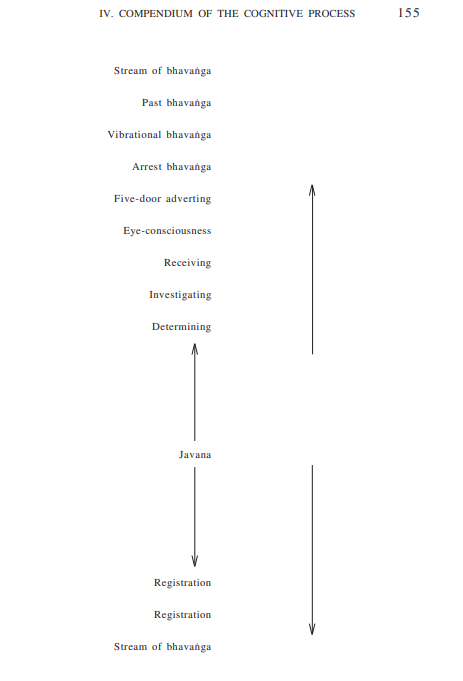
Sense door process from the Abhidhammatha sangaha (translation Bodhi) . You can see eye consciousness immediately after the five-door adverting.

this process is happening repeatedly and very quickly at this moment right now.

Thanks Robert. I sometimes hear teachers say that we should maintain bare awareness at the 5 sense consciousness, but by the sounds of it there is no wisdom in that at all.

Heh. I think there is a bit more to it when they talk about bare awareness . If they know Abhidhamma they would know that the sense door processes must occur in series and that mind door processes happen immediately after the sense door process. They would understand that javana cittas automatically arise after the moment of sense cognition.

What they are suggesting, I think, is that rather than get lost or react to the vipaka (the sense consciousness) there can be awareness instead. Which is true if conditions - including accumulated wisdom and sati - are present..

Where this can go wrong is students thinking they can control the process and have awareness by concentrating - they miss the main point of satipatthana which is to develop the perception of anatta.

Still I think the general idea of ‘bare awareness’ or ‘choiceless awareness’ is not too far from the right attitude to developing vipassana - but there needs to be more details and stress on anatta and conditionality and no control.

Following from this, at which stage in the cognitive process is it ideal to maintain awareness, before the whole things runs away from us so to speak?

As you know all elements arise because of conditions with no little manager controlling things somehow.

When we try to pin down a time/place/occasion/stage there may be a subtle idea that I will catch realities; I have heard people who think they can concentrate and somehow slow down the processes so they can observe the characteristics at leisure. This is the nature of self view.

The way it works, as I see it, is that by understanding more at the pariyatti level there is a gradual dismantling of wrong view. That level is starting to grasp the anattaness, the conditionality of all elements. There will be reflecting on this and concluding that life is as described in the texts.
Then there is the opportunity for sati of the level of satipatthana to arise and occasionally directly know some reality. This is of course very weak in the beginning. And this sati comes about not by trying but in association with detachment and understanding.

So more important than trying to maintain awareness is starting to confirm at whatever level that life is just as described - merely the khandhas, the dependent origination etc. If things do ‘run away with us’ that shows that phenomena are not under control i.e. it is revealing anatta.

(Where any sati comes in, if it does, is during the javana phase of either the sense door or mind door processes)

edit: I want to add that for samatha bhavana the way is a bit different. For that the hindrances are eliminated temporarily. There has to be precise understanding of wholesome and unwholesome cittas - and then the wholesome are encouraged and maintained for longer periods.

1 Like