In traditional Buddhist countries such as Sri Lanka and Myanmar, it is common that people exclaim “Buddha-Dhamma-Saṅgha” when they are afraid, shocked, stumble over something, or fail to do or achieve something. This habit is possibly coming from stories like this one about the Brahmin woman. In the Pāḷi Commentaries, there is a story of merchants sailing overseas whose ship was endangered by a whale. The sailors were Buddhists, so when the whale tried to overturn their ship, the merchants were scared and called out Aho gotamo bhagavā. The whale heard it and, as was its habit from a previous life when it practiced with the Buddha-to-be, the hermit Sumedha, respect towards the Buddha arose in its mind, and it died. (Now, after a long time of suffering in hell, it was a whale because, in a previous life, as a man, he associated with a bad friend and killed his mother.) The whale was then born as a human in Sāvatthī, became a monk, and later an Arahant. Apadāna Commentary 49. Paṃsukūlavaggo, v. 171.
thanks that makes it clearer.
MN 100 (First half Page 1-24).pdf (739.7 KB)
this is the first 24 pages reformatted. Let me know what you think of the format.
sarah from dsg made some comments:
Thank you for informing me. I have deleted the first two of the three things and edited the third to align with the orthodox nature of the text.
Sarah may like to comment directly inside the Google Doc, so that Robert does not have to inform me. The document is open for all comments, just click and add a comment right in the text.
We have improved the Google Docs version and added the header for every starting section, not just for every new section. In your version I can see that some tables have a header that is not really a header. See here -
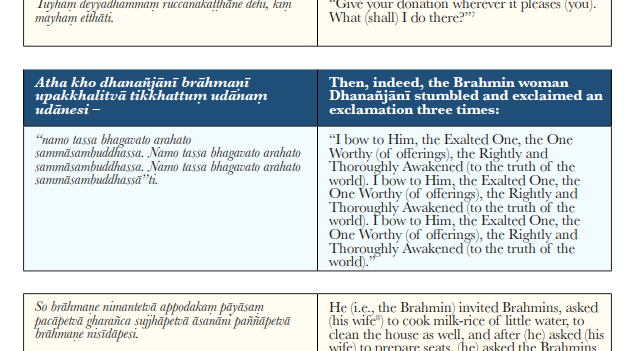
The header of the reference would surely be more congruent with the other tables. Please, kindly refer to our Google Docs version for the update.
Thank you so much for your great efforts in preparing this translation into a more eye-candy style. When done, I will (with your permission) ask my donors to print it out and distribute here in Vietnam.  Your idea is very nice. When you have finished, I can possibly ask my assistants to follow this style in all upcoming translations and later, if we get all 152 sutts translated, distribute them in this unified appearance.
I heard back from professor Alex Wynne. Unfortunately his efforts have stalled as until now he has been unable to secure the funding to work on it.
Crowd funding? Might get a bit raised posting it on here, DW and SC
In Thailand it is a 3 stringed Lute called a Pin. But it is Indra who comes and plays it when the Bodhisatta faints from his austere practices. It is included in the traditional biography called the Pathamasambodhikatha are short version of which was translated in" “The Wheel of the Law: Buddhism, Illustrated from Siamese Sources” by Alabaster in the 1870s. This in turn was a source for Arnold’s “The Light of Asia":
And on another day there passed that road
     A band of tinselled, girls, the nautch-dancers
     Of Indra's temple in the town, with those
     Who made their music—one that beat a drum
     Set round with peacock-feathers, one that blew
     The piping bansuli, and one that twitched
     A three-string sitar.  Lightly tripped they down
     From ledge to ledge and through the chequered paths
     To some gay festival, the silver bells
     Chiming soft peals about the small brown feet,
     Armlets and wrist-rings tattling answer shrill;
     While he that bore the sitar thrummed and twanged
     His threads of brass, and she beside him sang—

     "Fair goes the dancing when the sitar's tuned;
     Tune us the sitar neither low nor high,
     And we will dance away the hearts of men.

     "The string o'erstretched breaks, and the music flies,
     The string o'erslack is dumb, and music dies;
     Tune us the sitar neither low nor high."
So the image was transmitted or perhaps “transmogrified” (to use a Victorian expression) in the first popular Western life story of the Buddha.
A little diversion but as the Thai version is at least 500 years old, was wondering if the versions you mentioned have been influenced by the Western Victorian version?
Anyway what I wanted to post was I found this website with English and Burmese Nissaya translations of 50 of the Majjhima Agama Suttas: