Anattalakkhana Sutta and Abhidhamma Vibhaṅga

I just gave a Dhamma talk based on the Anattalakkhaṇa Sutta using the Abhidhamma to explain the 11 ways. As far as I know, nobody in the English world has explained the meaning according to the Abhidhamma. It is not my teaching, it is the Abhidhamma explanation. Other talks building up to this teaching are found here

The last 3 pairs were a mystery to me considering the last four nāma khandhas and I wanted to know what they were.

  • Gross and subtle
  • Inferior and superior
  • Near and far

Through searching, it was found in the first chapter right at the very beginning of the Abhidhamma Vibhaṅga!

Generally speaking:

  • Unwholesome is gross and inferior and far to wholesome
  • Wholesome is gross and inferior and far to indeterminate cittas
  • Both wholesome and unwholesome is gross and inferior and far to indeterminate cittas.
    Attainments.
    Being free from āsavas.

Being near is being of the same class of citta.

I found this to be very useful.

Example here:

18. tattha katamā saññā hīnā paṇītā?
18. In that regard, which perception is inferior or superior?
akusalā saññā hīnā, kusalābyākatā saññā paṇītā.
Unwholesome perception is inferior; wholesome and indeterminate perception is superior.
kusalākusalā saññā hīnā, abyākatā saññā paṇītā.
Wholesome and unwholesome perception is inferior; indeterminate perception is superior.
dukkhāya vedanāya sampayuttā saññā hīnā, sukhāya ca adukkhamasukhāya ca vedanāhi sampayuttā saññā paṇītā.
Perception conjoined with painful feeling is inferior; perception conjoined with pleasant feeling and neither-painful-nor-pleasant feeling is superior.
sukhadukkhāhi vedanāhi sampayuttā saññā hīnā, adukkhamasukhāya vedanāya sampayuttā saññā paṇītā.
Perception conjoined with pleasant and painful feelings is inferior; perception conjoined with neither-painful-nor-pleasant feeling is superior.
asamāpannassa saññā hīnā, samāpannassa saññā paṇītā.
Perception of one not in attainment is inferior; perception of one in attainment is superior.
sāsavā saññā hīnā, anāsavā saññā paṇītā.
Perception with taints is inferior; perception without taints is superior.
taṃ taṃ vā pana saññaṃ upādāyupādāya saññā hīnā paṇītā daṭṭhabbā.
Or, by taking this and that perception, perception is to be seen as inferior or superior.
I think that most of the Abhidhamma knowledge stems from the Abhidhammatthasaṅgaha. As few Westerners actually make it through the course to give meaning to the rest of the Abhidhamma books, we tend to lose the ability to read other items. Furthermore, reading the mūla Abhidhamma books takes some discipline. I am very lucky to have created TPR and using the Tipiṭaka translations along with the AI searching which helped me find this “standard” explanation of the 11 ways. Being in the first pages of the first chapter of the book on Khandhas makes it very important to read and understand.

1 Like

Here is the post based on the talk and the one I gave translated on the Full Moon Day.

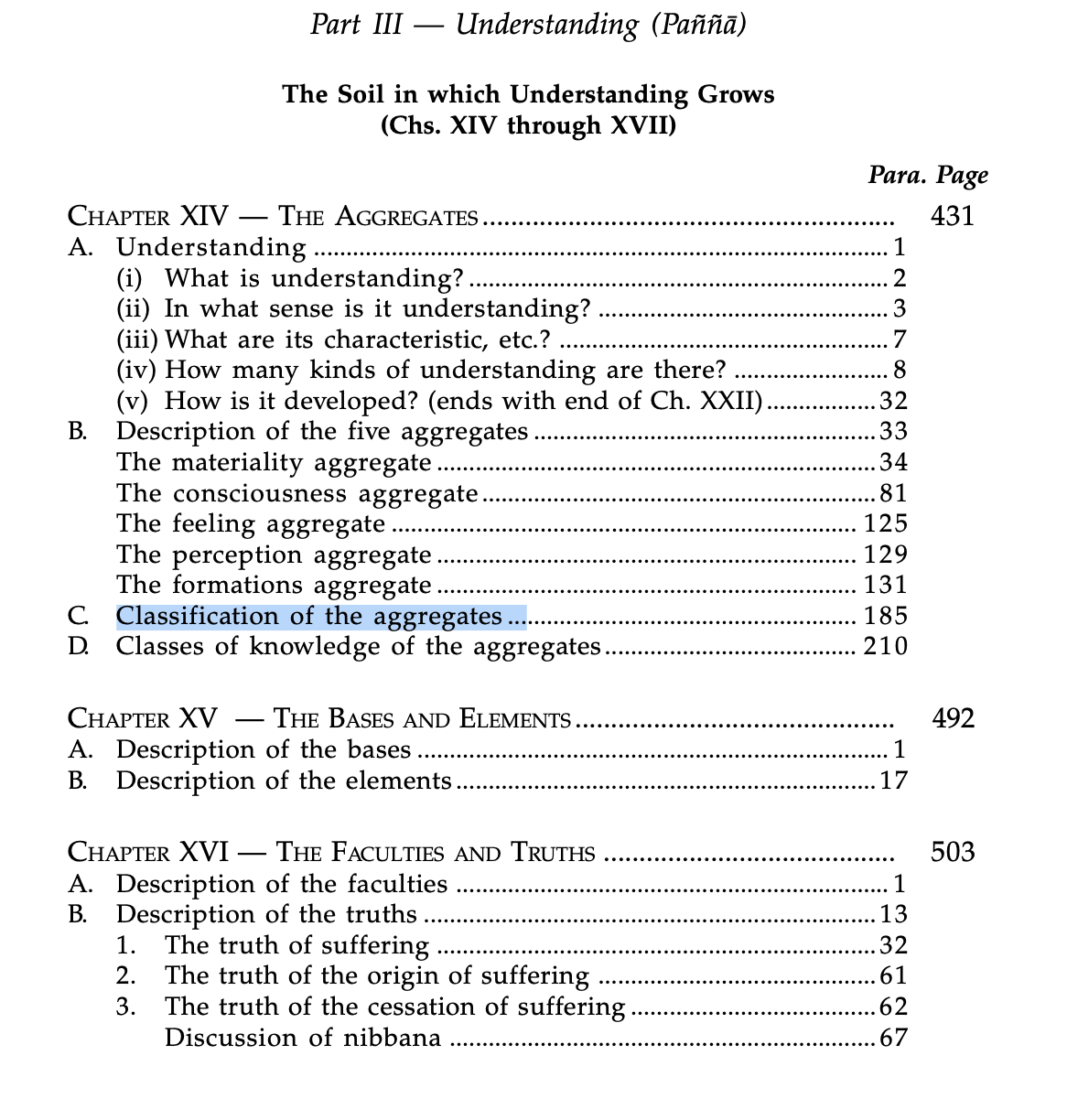
It is in the visuddhimagga in the aggregates section of Panna under the heading “Classification of aggregates”

1 Like

The Anattalakkhaṇa Sutta is rarely talked about in terms of suttas meant for practice. Instead, we normally only hear about two suttas for meditation: the Satipaṭṭhāna Sutta (The Foundations of Mindfulness)

Yes, and Anatta is the key of the teaching - if this is not understood then the teaching can’t be understood. It says

“Feeling is nonself…. … Perception is nonself…. Volitional formations are nonself…. Consciousness is nonself. For if, bhikkhus, consciousness were self, this consciousness would not lead to affliction, and it would be possible to have it of consciousness: ‘Let my consciousness be thus; let my consciousness not be thus.’ But because consciousness is nonself, consciousness leads to affliction, and it is not possible to have it of consciousness: ‘Let my consciousness be thus; let my consciousness not be thus.’

yet many misunderstand or ignore. Today I saw on dhammawheel a post:

Anyone with some extended exercise can raise sati in an instant, when sitting down to intentional meditation.

Thus many Buddhists, believe that sati is under their control. But actually it is utterly anatta, it arises by conditions, there is not a hint of self who could control any moment.

Even the satipatthana sutta is at heart about anatta:

The type of sati of satipatthana arises in conjunction with wisdom, Thus: it is sati-sampajanna, mindfulness and clear comprehension.
It is a momentary arising of insight that understands to some degree the anattaness of a reality.

This profound type of mindfulness is only possible during a Buddhasasana, and only if there is enough accumulated understanding based on wise consideration of correct Dhamma.
The commentary to the satipatthana sutta
The Section on the Modes of Deportment

The Buddha, after dealing in the aforesaid manner with body-contemplation in the form of respiration-meditation, in detail, said: “And further,” in order to deal exhaustively with body-contemplation, here, according to the meditation on the modes of deportment [iriyapatha].

Gacchanto va gacchamiti pajanati When he is going (a bhikkhu) understands: ‘I am going.’
In this matter of going, readily do dogs, jackals and the like, know when they move on that they are moving. But this instruction on the modes of deportment was not given concerning similar awareness, because awareness of that sort belonging to animals does not shed the belief in a living being, does not knock out the percept of a soul, and neither becomes a subject of meditation nor the development of the Arousing of Mindfulness.

Going. The term is applicable both to the awareness of the fact of moving on and to the knowledge of the (true) characteristic qualities of moving on. The terms sitting, standing and lying down, too, are applicable in the general sense of awareness and in the particular sense of knowledge of the (true) characteristic qualities. Here (in this discourse) the particular and not the general sense of awareness is to be taken. [b

From the sort of mere awareness denoted by reference to canines and the like, proceeds the idea of a soul, the perverted perception, with the belief that there is a doer and an experiencer. One who does not uproot or remove that wrong perception owing to non-opposition to that perception and to absence of contemplative practice cannot be called one who develops anything like a subject of meditation.

From the Vibhaṅga, we can see 28 rūpas to define the 11 ways. The Abhidhamma is the sensible way to define these 11 ways. For coarse objects, we have 3 mahābhūta, 5 sense door sensitivity, color, sound, smell, and taste as 12. The remaining 16 are subtle.

vibhaṅgapāḷi

5. tattha katamaṃ rūpaṃ oḷārikaṃ?
Among these, which form is gross?
cakkhāyatanaṃ … pe … phoṭṭhabbāyatanaṃ – idaṃ vuccati rūpaṃ oḷārikaṃ.
The eye sense base … until … the tangible sense base—this is called gross form.
tattha katamaṃ rūpaṃ sukhumaṃ?
Among these, which form is subtle?
itthindriyaṃ … pe … kabaḷīkāro āhāro – idaṃ vuccati rūpaṃ sukhumaṃ.
The feminine faculty … until … physical nutriment—this is called subtle form.

1 Like

When people understand through experience that eye sensitivity is impermanent, they will understand that contact and eye consciousness are also impermanent and, of course, occurring very rapidly. This is all seen in the sutta, and also in the Abhidhamma, and also the subcommentarial Abhidhamma through kalāpas and the breaking up of compactness (ghana). It is also the link to understand how nāmarūpa are connected and separate.

1 Like